
This Week In Debt: 10/20/2025
Sigh of relief.

Hi,
It’s tough out there, but breathe with me a sigh of relief. Bank profits grew even beyond expectations last quarter.

For the three months through September, JPMorgan Chase reported a 12 percent year-over-year increase in profit to $14.4 billion on revenue of $46.4 billion. Investment banking fees rose 16 percent, and credit card and auto lending revenue rose 12 percent, a sign of solid business on both Wall Street and Main Street.
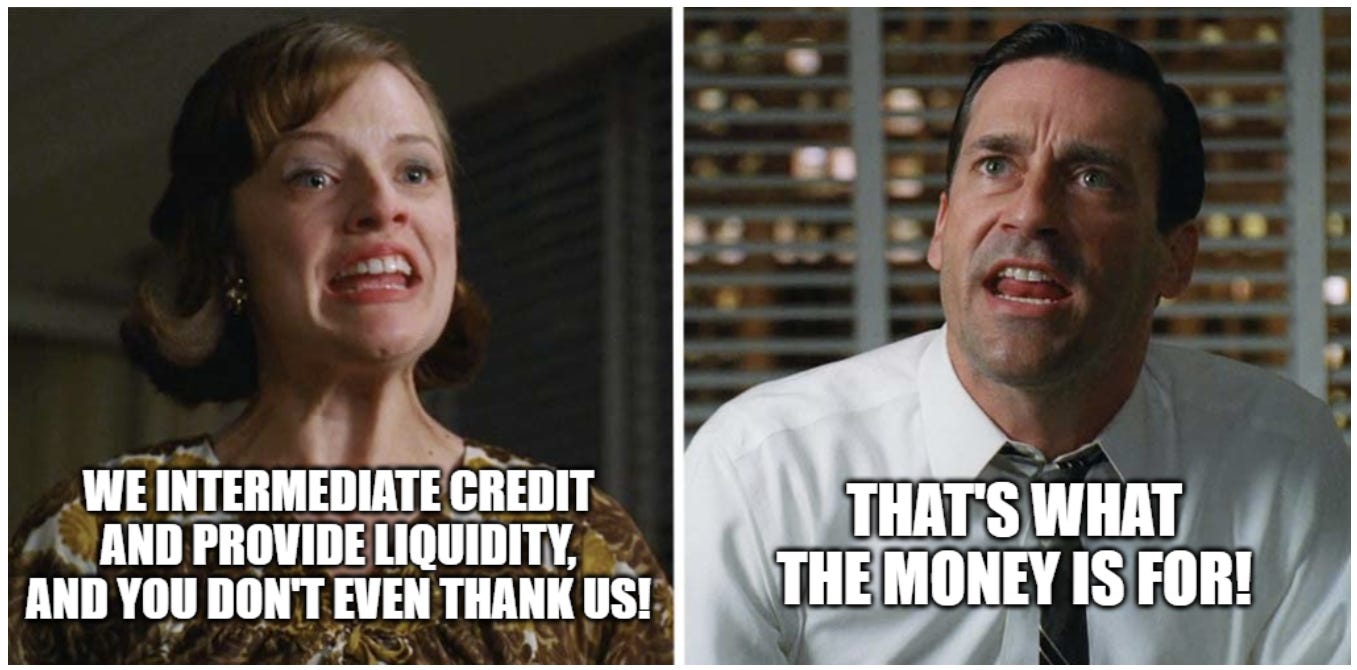
Regional banks are doing great too. Keep this in mind, then, next time a bank or the bank lobby is whiny:
But enough of my own whining. We’re here to talk consumer debt and its consequences for America. The best of the week on those topics is below. Savor it.
So without further ado . . .
This Week In Debt: 10/20/2025
Let’s start with good news. States have really been on a tear over the past week! Some highlights:
California bans Training Repayment Agreements Provisions (TRAPs, see?) and other “stay-or-pay” contracts that hurt workers (emphasis added below):
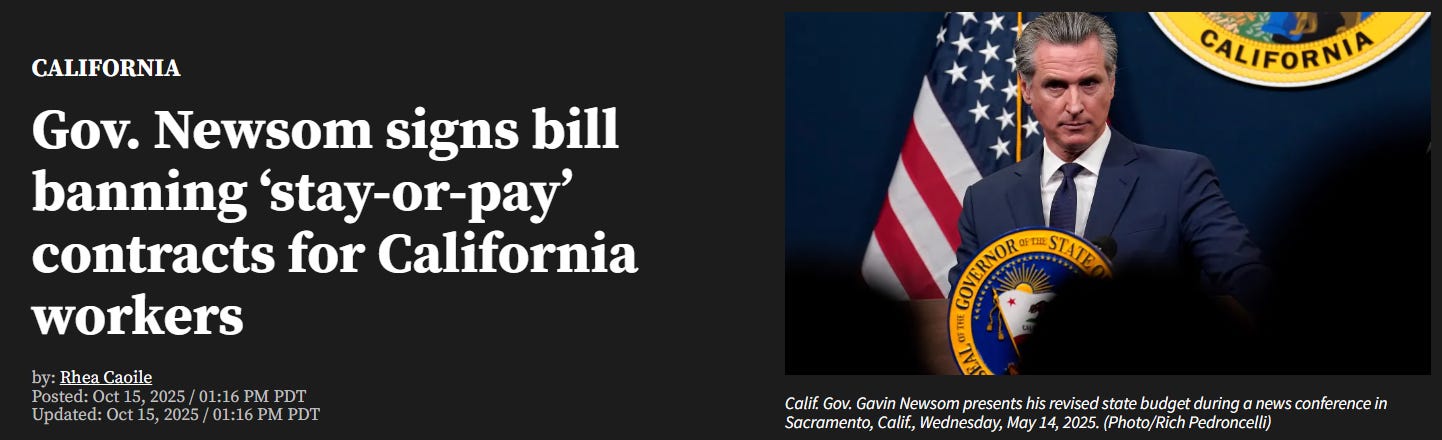
That’s Gavin’s serious face.
Gov. Gavin Newsom recently signed several bills into law that will impact California workers starting next year, including one that prevents trapping them in debt. Assembly Bill 692, which was introduced by Assemblymember Ash Kalra, bans employers from threatening workers with having to pay to quit their job.
Statement from Protect Borrowers Senior Policy Advisor Chris Hicks here.
California also passed the “CARS ACT,” which outlaws a variety of predatory practices in auto lending. Sam Levine (former Director of the FTC’s Bureau of Consumer Protection) and Erin Witte (Director of Consumer Protection at the Consumer Federation of America) wrote in this very Substack about it (emphasis added):
Gavin Newsom signed SB 766, the CARS Act. Introduced and championed by Senator Ben Allen, CARS takes a major step toward restoring some dignity to Californians who want reliable, affordable cars without getting the runaround from dishonest dealers. The new law is straightforward: car dealers have to be upfront and honest about the total price of the car, they cannot sell worthless add-ons, and they have to give used car buyers a three-day cooling off period post-purchase—helping to ensure that dealers can’t get away with selling consumers a lemon. These commonsense reforms are conservatively estimated to save California car buyers $234 million and 8.5 million hours each year.
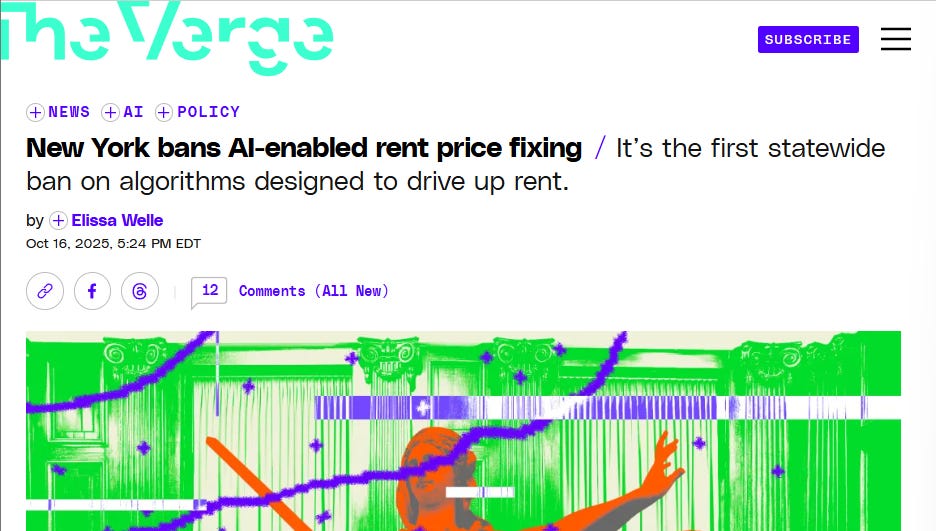
New York banned algorithmic rental price fixing:
On Thursday, New York Gov. Kathy Hochul signed into law legislation banning the use of price-fixing software by landlords to set rental rates. New York is the first state to outlaw algorithmic pricing by landlords, following a number of city-wide bans in Jersey City, Philadelphia, San Francisco, and Seattle.
. . .
[T]he “private data algorithms” advertised by these software companies [like RealPage], Hochul says, cause the “housing market distortion” that harms renters “during a historic housing supply and affordability crisis.”
The CFPB, however, continues being torn up (emphasis added):
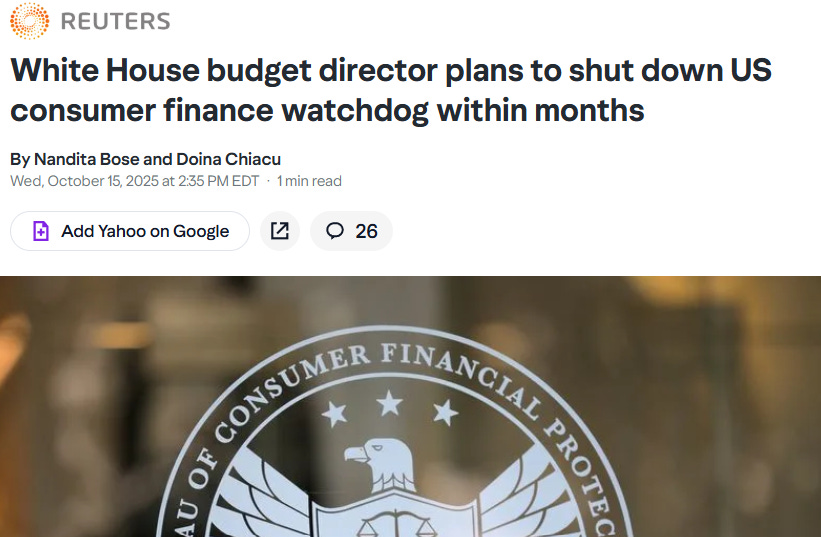
White House budget director Russell Vought said on Wednesday he wants to close the U.S. Consumer Financial Protection Bureau and expects to do so within the next two to three months.
. . .
“People say consumer financial protection - don’t we want to protect consumers? Absolutely. This agency wasn’t doing it - it had the DNA of Elizabeth Warren,” Vought said on “The Charlie Kirk Show,” referring to the Democratic U.S. senator who was the 14-year-old agency’s key architect.
. . .
“All they want to do is weaponize the tools of financial laws against basically small mom-and-pop lenders and other small financial institutions,” [Vought] said.
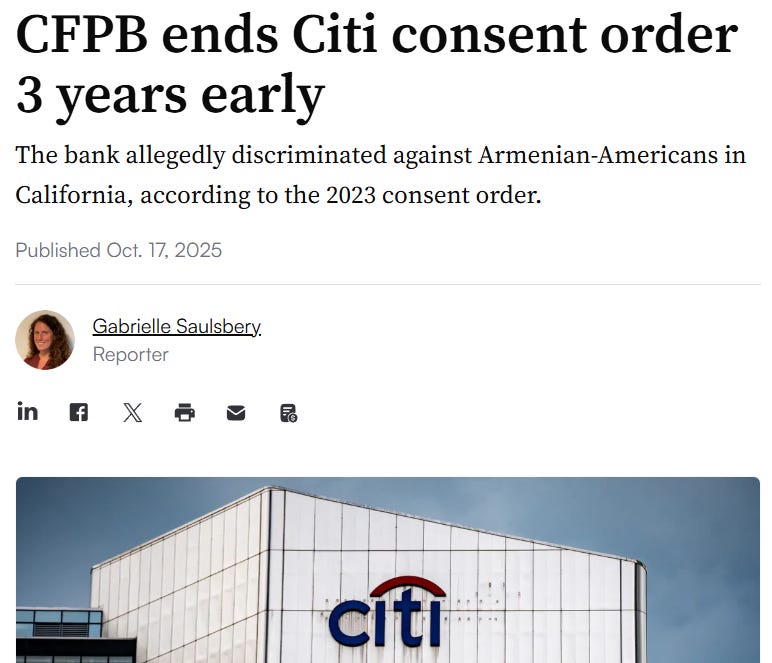
As part of that defense of “small mom-and-pop lenders:” Vought also killed the CFPB’s 2023 consent order against Citigroup for openly discriminating against Armenian-Americans:
In THIS Ohio diner . . .
On the topic, the New Yorker and ProPublica teamed up for a long read on Russ Vought and Trump’s wrecking of the administrative state.
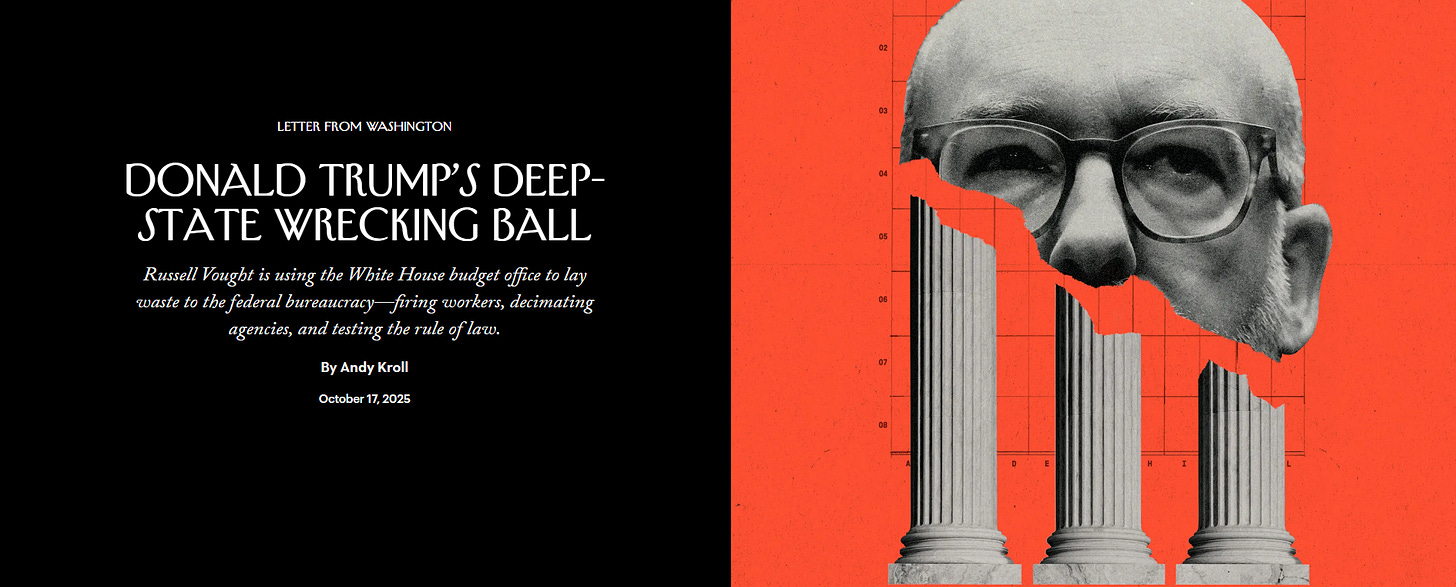
The article is in some way about how Vought earned his way to the spot of wrecker-in-chief. E.g. (emphasis added):
After the pro-Trump riots at the U.S. Capitol on January 6, 2021, many Republicans, including top Administration officials, disavowed the President. Vought remained loyal. He echoed Trump’s baseless claims about election fraud and publicly defended people who were arrested for their participation in the melee. During the Biden years, Vought labored to translate the lessons of Trump’s tumultuous first term into a more effective second Presidency. He chaired the transition portion of Project 2025, a joint effort by a coalition of conservative groups to develop a road map for the next Republican Administration, helping to draft some three hundred and fifty executive orders, regulations, and other plans to more fully empower the President. “Despite his best thinking and the aggressive things they tried in Trump One, nothing really stuck,” a former O.M.B. branch chief who served under Vought during the first Trump Administration told me. “Most Administrations don’t get a four-year pause or have the chance to think about ‘Why isn’t this working?’ ” The former branch chief added, “Now he gets to come back and steamroll everyone.”
Read on for more about how he self-identifies as a Christian nationalist, understands his enemies to be a “cartel” of Marxists, and more!
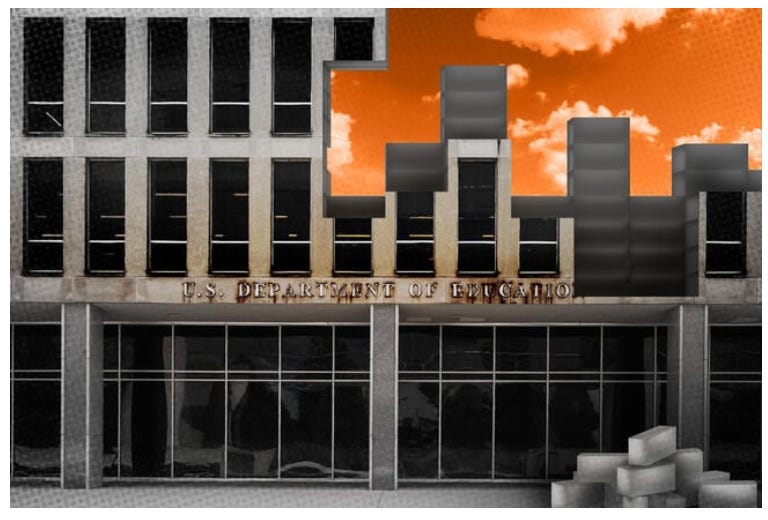
Inside Higher Ed’s Jessica Blake reports from student financial aid land: Trump’s Layoffs Gut Office of Postsecondary Ed. Folks, the graphics!
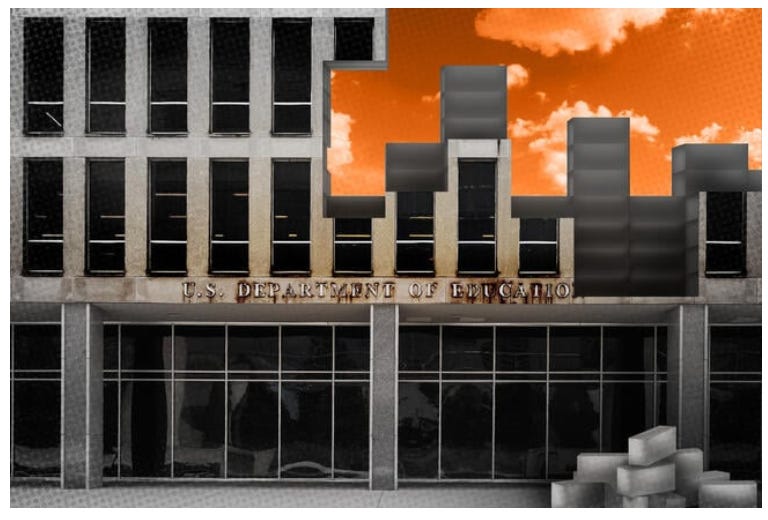
Education Secretary Linda McMahon has essentially gutted the postsecondary student services division of her department, leaving TRIO grant recipients and leaders of other college preparation programs with no one to turn to.
. . .
The consequence, college-access advocates say, is that institutions might not be able to offer the same level of support to thousands of low-income and first-generation prospective students.
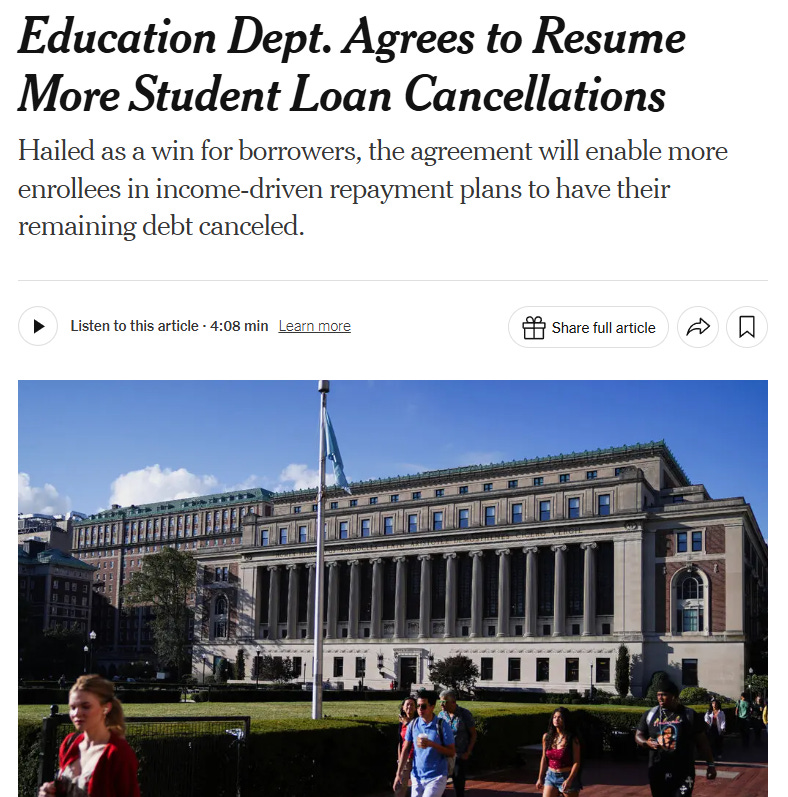
The agreement stems from a lawsuit brought by the American Federation of Teachers and Protect Borrowers. From the article:
More student loan borrowers enrolled in plans that had been temporarily blocked from federal loan cancellation may soon be able to receive that relief, while also ensuring they’ll avoid potentially painful tax bills.
. . .
The agreement makes clear that borrowers in income-driven repayment plans who have made enough qualifying payments in 2025 will not be subject to those taxes, regardless of which I.D.R. plan they are in or when the cancellation is processed . . . .
The Education Department agreed to continue to process loan discharges for eligible borrowers in the Income-Contingent Repayment (I.C.R.) and Pay as You Earn (PAYE) plans — as long as they’re still in effect. (The giant reconciliation bill passed last summer dismantles the two programs in 2028.)
WaPo has coverage of a new report on how using a loyalty program can cost you money via surveillance pricing.

The article arises out of a new report on the topic from Sam Levine (same one as above!) and Stephanie Nguyen (a Senior Fellow at the Vanderbilt Policy Accelerator and the former Chief Technologist at the FTC). Basically, companies use loyalty programs and AI to ID those repeat customers who are likely to be willing to pay more for the same product. This stands in contrast to the common understanding of rewards programs, which present themselves as offering customers a pat on the back for their fidelity. From the article:
Many loyalty programs, from airlines to grocery, build dossiers on customers — tracking cursor movements, location, browsing history, even buying data from others — to make judgments about your income, personality, habits and willingness to pay.
. . .
Levine and Nguyen say loyalty programs are turning into engines for “surveillance pricing” — when companies use AI and personal data to set individualized prices, a.k.a. personalized markups.
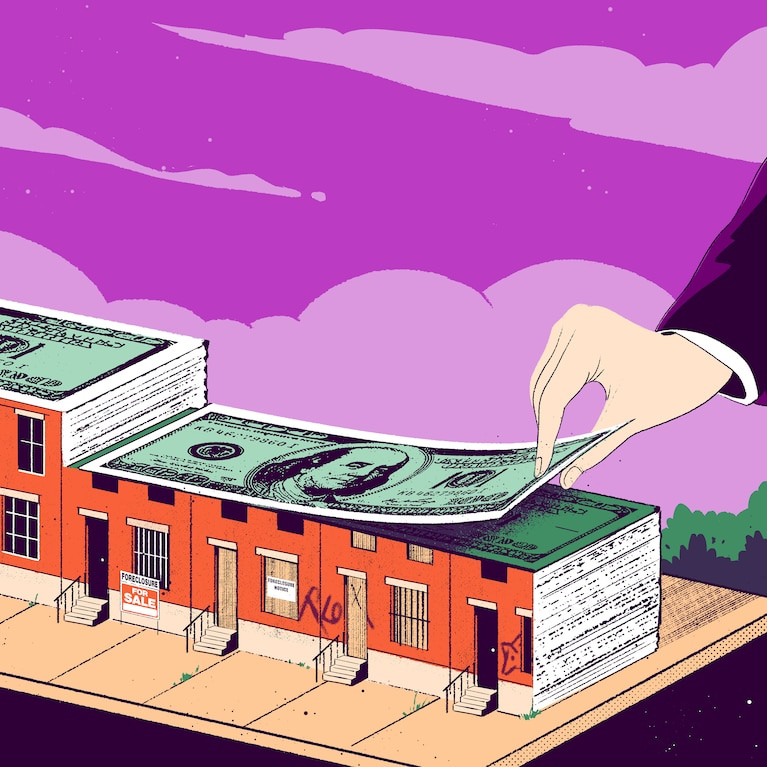
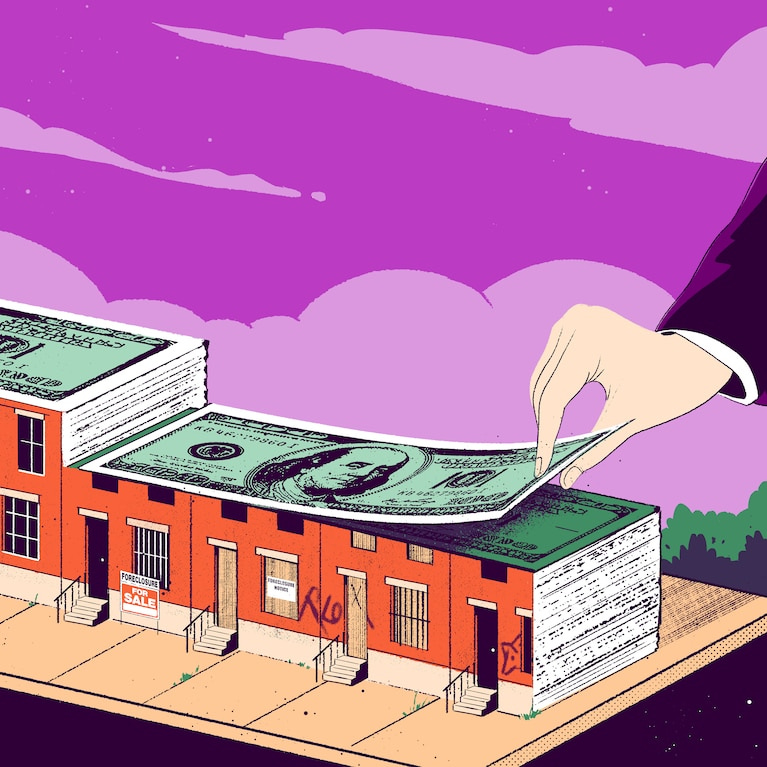
Local reporting, baby! The Baltimore Banner reports on how NYC investors led a speculative boom and bust in Baltimore housing that pushed hundreds of homes into foreclosure (once again, the graphics!; emphasis added below):
Diana Scott’s East Baltimore rowhouse isn’t perfect, but for the last five years, it’s given her family stability in an economy where everything from gas to groceries costs more.
Every month the family of five pays $1,100 — an attractive rent considering the value of the home has tripled during their tenancy, at least on paper. Then the foreclosure notice arrived.
Something peculiar is happening to Scott’s home, along with nearly a dozen more on her street and up to 704 across Baltimore. In concentrated pockets of the city’s East and West sides, many of the homes have hit the auction block this year at noticeably inflated prices. And no one is biting.
Scott’s home is part of a portfolio linked to New York buyers who leaned on a newly popular mortgage loan product to buy hundreds of homes in Baltimore. Private equity funds have fueled its rise, and with many of the mortgages now in default, lenders and noteholders have been left holding the bag.
And finally, some potpourri:
Speaking of consumer debt: Nicki Minaj’s $20 Million L.A. Home at Risk of Being Seized Over Massive Debt Owed
US jury finds French bank BNP Paribas complicit in Sudan atrocities
At Better Markets, Amanda Fischer writes on how the SEC is using/abusing “staff statements” and other dubious legal moves to avoid the APA
WSJ: The Numbers Six and Seven Are Making Life Hell for Math Teachers
Veronica Riccobene in the Lever: Four Ways Private Equity Might Kill You
Youtube Guy Mr. Beast may be launching a bank?
The way BoJo pronounces ChatGPT . . .
New Yorker: Inside the Trump Administration’s Assault on Higher Education (there’s also an audio version)
How’s Nikola Motors fraudster and Trump pardonee Trevor Milton doing?
How’s Great Khan Pritzker doing? Pretty well: Gov. JB Pritzker won $1.4 million in Vegas playing blackjack
And how’s Tai Lopez doing? SEC Says ‘Here in My Garage’ YouTuber Tai Lopez Ran a Ponzi Scheme
Eric Trump: “I am a good boy”
David Seligman and Luke Goldstein visited David Sirota’s Lever Time podcast to discuss “How Ticketmaster Made It Impossible To Sue Them”
Say hello to the “truckle”
Peter Thiel continues thinking everyone he doesn’t like is the antichrist. How does the song go?
And it won’t make one bit of difference if I answer right or wrong
When you’re rich, they think you really know!







Have a great week!
 | A guest post by
|