

This Week In Debt: 10/6/2025
Everything is about UDAAPs.

Morning,
Everything is about UDAAPs. Except UDAAPs. UDAAPs are about market power.[1]
That stays the same regardless of whether the government is shut down. Betting markets think that will remain the case for a total of 10 to 15 days, so get moderately comfortable. In the meantime, I call on all of you to continue raging against the market power machine and its disastrous consequences for the human race.
As for me? Free of the restraints of a functional government, I have hidden my head over the past week in the sand of the internet. And boy, has it been coarse. I now emerge, sandy-haired, full of fear and trembling, and ready to offer a glimpse into the absurd. My expert selections of the best of the internet over the past week are included below.
May g*d have mercy on all of our souls, and good yontif to those who observed Yom Kippur.
So without further ado . . .
This Week In Debt: 10/6/2025
At the Lever, Luke Goldstein has a great read on the bank-ification of everything—and what it means for the rest of us (also, huge shoutout to the graphics department here):
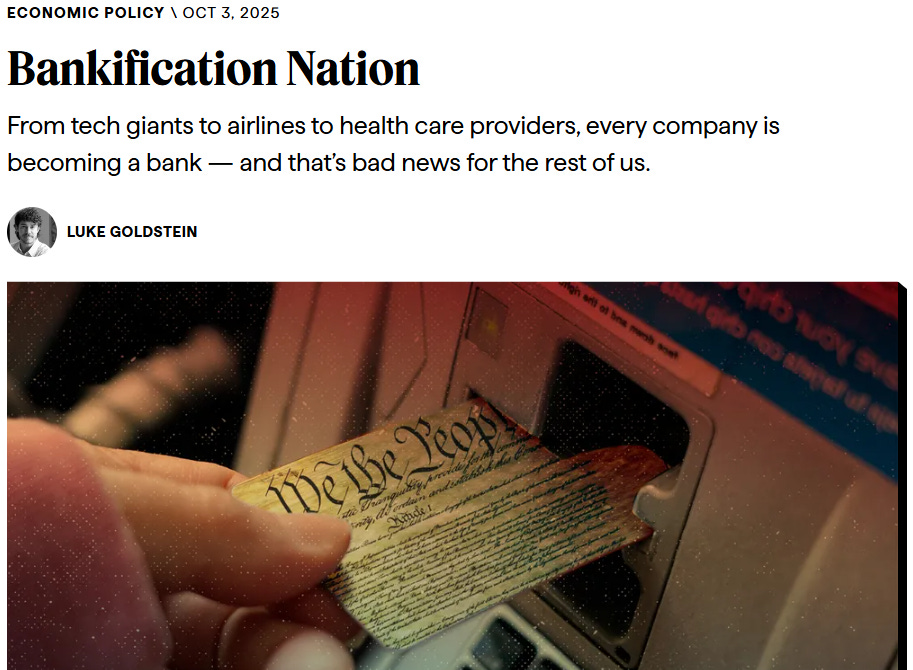
Upward of 40 percent of Americans now pay for basic items like groceries and health care using borrowed money — and this excludes credit cards. A third of younger Americans hold their savings on nonbank tech platforms like Venmo, and industries from retail to transportation derive anywhere from 14 percent to half of their profits from partnerships with credit card companies.
While this new type of financialization takes many different forms, the endgame is the same: Most major corporations now aspire to become unregulated banks, opening up new avenues to make even more money hand over fist. Banks operating credit cards are the highest-profit-margin enterprises in the economy. Every company wants a share of the loot, amassed from high fees and low overhead costs.
House Dems write to the admin with concerns that the Department of Education may be collecting on defaulted federal student loan borrowers without giving required notice.
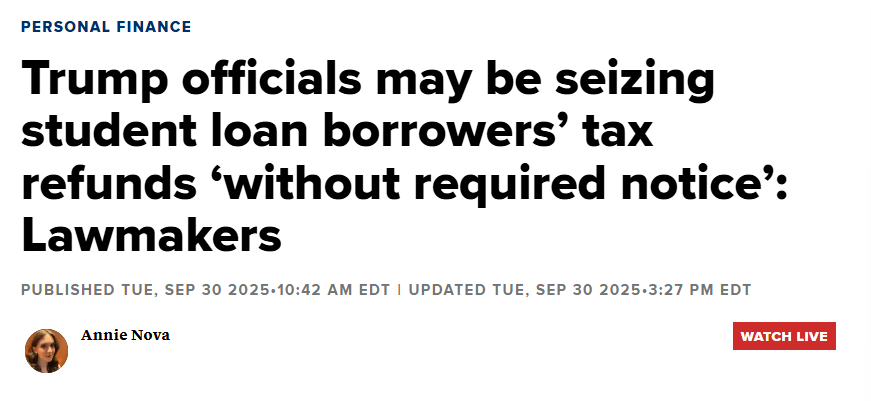
Those collections are drastic—they happen through wage garnishment, the seizure of benefits including Social Security payments, the docking of tax refunds, and more. ED is supposed to tell people 65 days before collecting, but it’s now taking the position that ANY warning about a collection—even if it was years ago—is enough. About 10 million federal borrowers are already in or very close to default.
Also from student world this week:
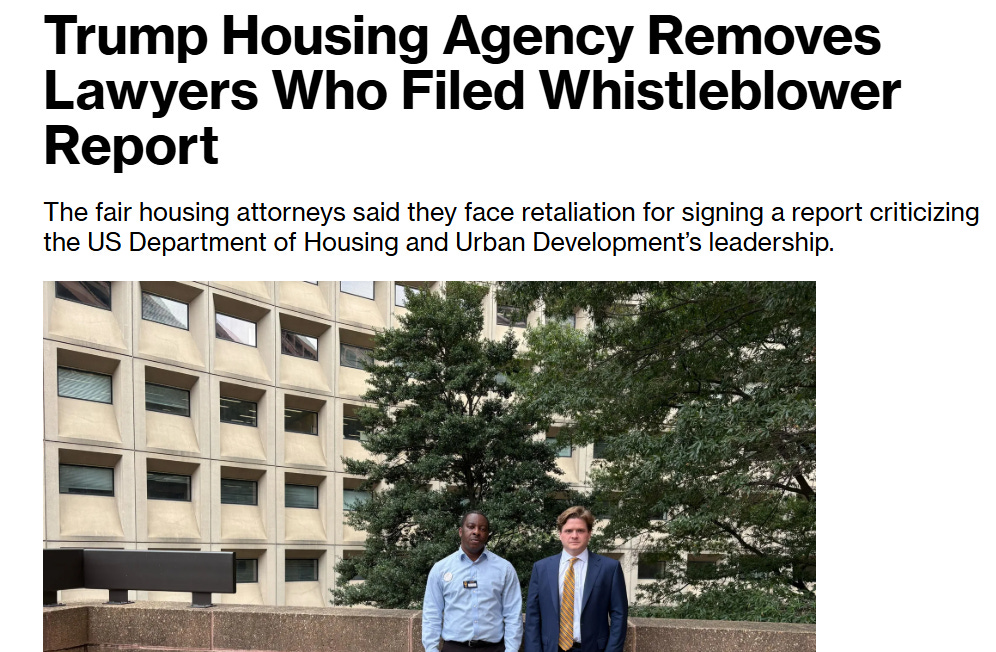
Trump’s HUD is going after whistleblowers:
(Emphasis added)
The Department of Housing and Urban Development moved to fire two HUD civil rights attorneys who signed a whistleblower disclosure alleging a pullback in fair housing enforcement at the agency.
. . .
The whistleblowers raised alarms that the agency has gutted the Office of Fair Housing and Equal Opportunity and reassigned the majority of its lawyers, withdrawn past discrimination charges, and disrupted the work of local fair housing organizations. The consequences of these changes, the attorneys believe, will include “legal violations, gross mismanagement, gross waste of funds, and present a specific danger to public health and safety.”
CFPB is opening a probe into the alleged “debanking” of conservatives.
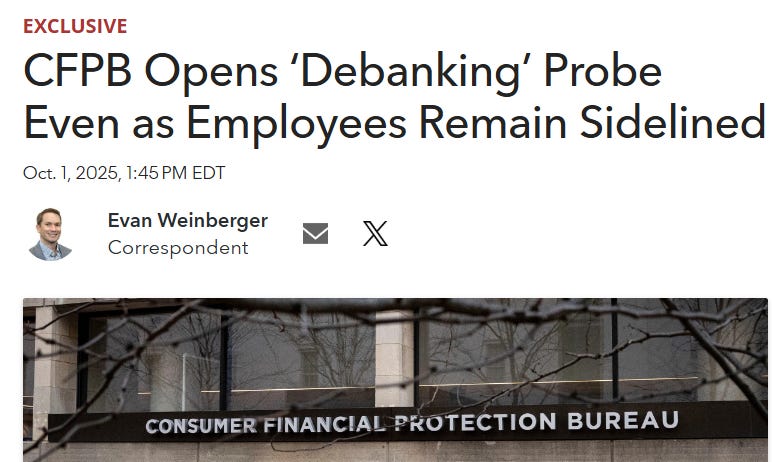
The Consumer Financial Protection Bureau is asking its enforcement attorneys and a small team of examiners to flag investigations that uncovered potential “debanking” of customers based on religious or political beliefs, even as the agency’s fair lending and other enforcement efforts have largely screeched to a halt.
CFPB enforcement attorneys received an email Sept. 26 instructing them to “identify current and past investigations where we obtained information related to an entity’s reasons for refusing to open accounts, freezing accounts, or closing accounts.”
Recall, of course, that the Trump/Andreessen debanking narrative has always been BS.
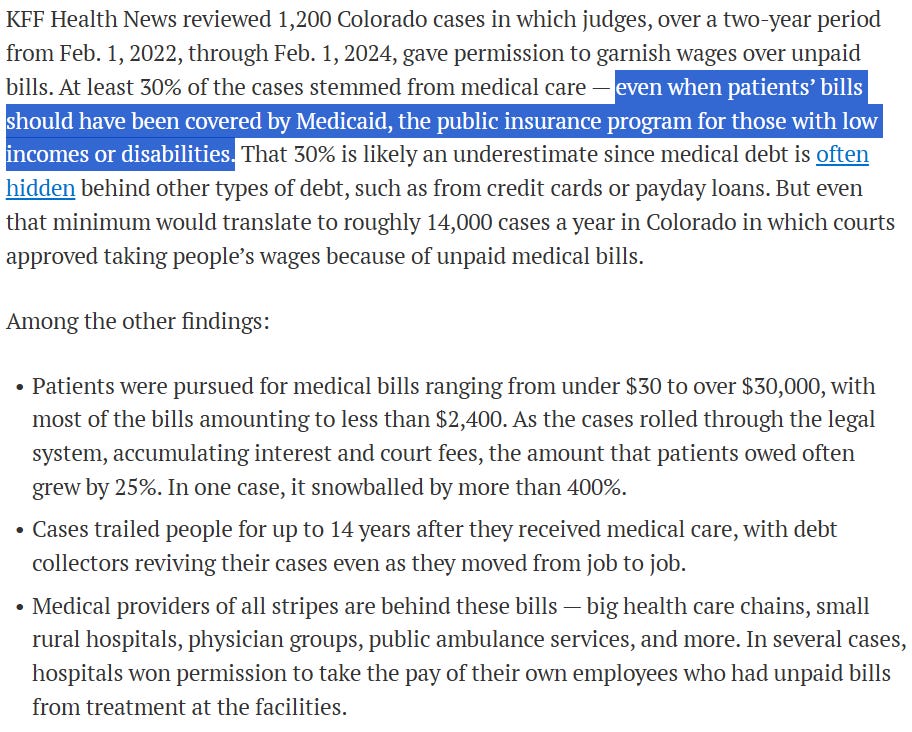
The kind of story that ruins your week, and it’s only 7AM on Monday: In Colorado, Workers’ Wages Siphoned To Pay Medical Bills, Despite Consumer Protections. KFF Health News reports on judges allowing for wage garnishments over unpaid medical bills, even when those bills should have been covered by Medicaid.
Erstwhile 30-Under-30er Charlie Javice, of Frank fraud fame, was sentenced to 7 years in the pokie for selling JPMorgan a student loan-flavored bill of goods for $175 million. She also apparently went on to cost JPM “some $115 million in legal fees.”
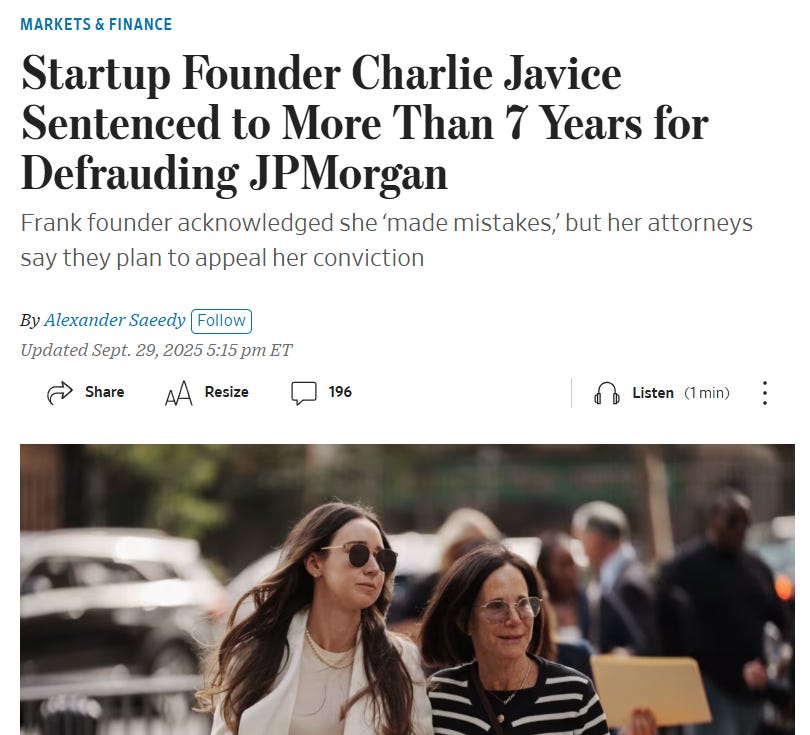
Many people who read this newsletter have done important work to hold banks accountable. But have you . . . cost them almost $300 million? It’s called praxis, folks.
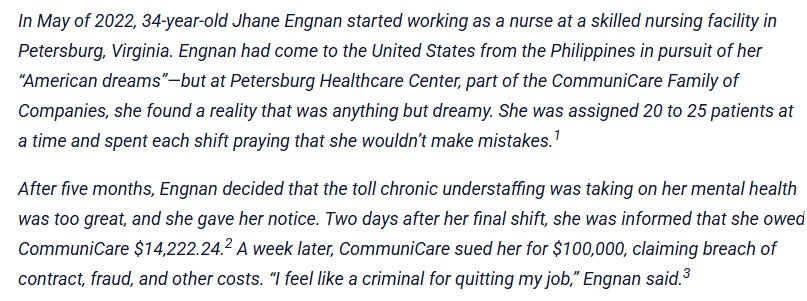
In the Fall 2025 edition of American Federation of Teachers’ Health Care magazine (and on this Substack, and on PB’s website), PB Senior Policy Advisor Chris Hicks writes about “How Employers Snare Healthcare Workers in Debt.” The opening vignette gives a [bitter] taste:
Seems bad! Joseph Cox in 404 Media on ApproveShield and Argyle hoovering up workers’ data in ways that could be illegal (emphasis added):
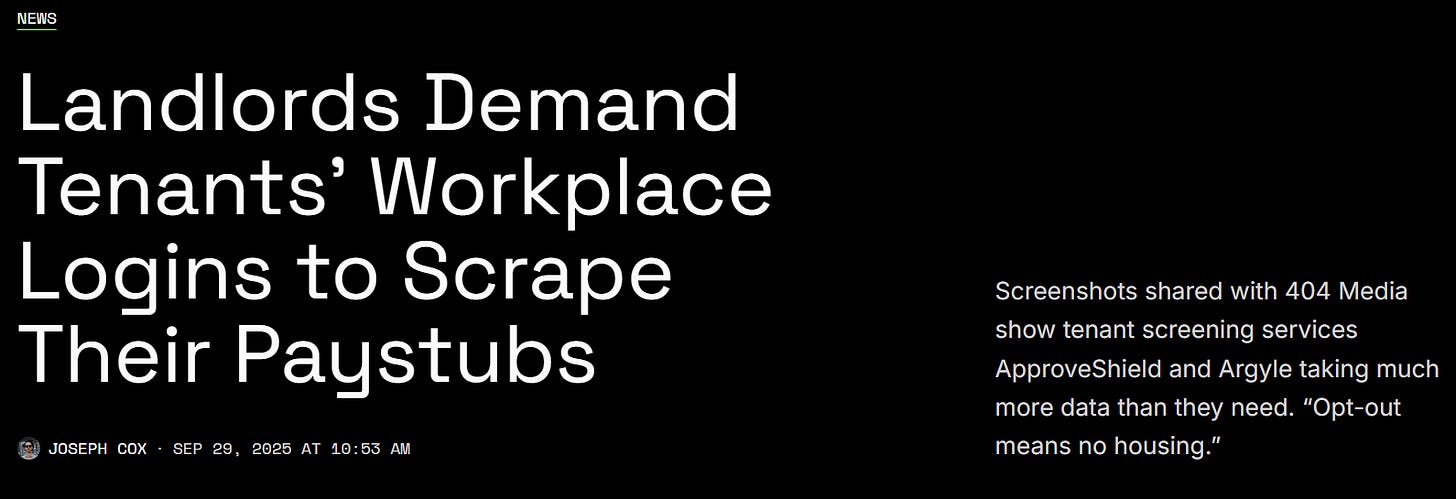
Landlords are using a service that logs into a potential renter’s employer systems and scrapes their paystubs and other information en masse, potentially in violation of U.S. hacking laws, according to screenshots of the tool shared with 404 Media.
The screenshots highlight the intrusive methods some landlords use when screening potential tenants, taking information they may not need, or legally be entitled to, to assess a renter.
At Roosevelt, Alabama Law Assistant Prof. Luke Herrine has a great long-read that “traces the development of state higher education structures through the 20th century, focusing on how state governments have managed their public colleges as systems and how that management has contributed to various outcomes for students.”[2]
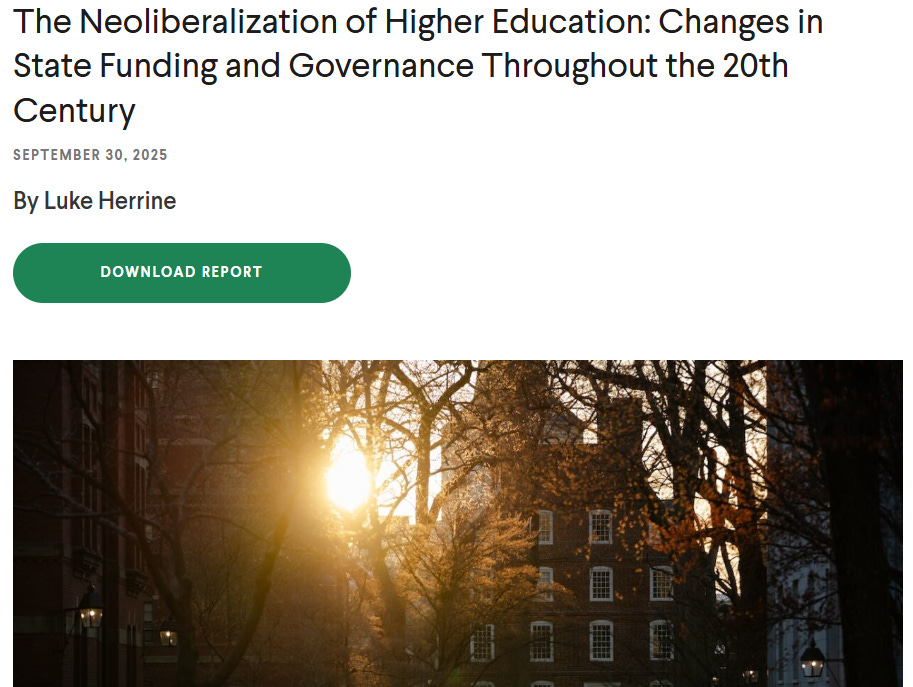
Pulling some pull quotes (emphasis added):
Over the first part of the 20th century, public higher education institutions expanded massively, and states developed bureaucratic planning bodies to ensure they expanded in ways that provided broadly shared benefits. Starting in the late 1970s, however, states began to pick apart these institutions and implement austerity, leading to a more competitive, revenue-focused, and increasingly unequal system that was also more shaped by elected politicians than career bureaucrats.
. . .
Under the influence of a new generation of policy thinkers who saw public institutions as lesser versions of capitalist firms, state legislatures began to disempower independent planning commissions, replacing them with efforts to promote market-mediated accountability and with more powerful governors. Meanwhile, universities themselves began to operate more like private firms: diversifying revenue streams, raising tuition, and increasing administrative costs while economizing on faculty. The result was public colleges with less-reliable state subsidies that operated more like their private counterparts.
WH withdraws the nomination of Heritage alumn EJ Antoni to lead the Bureau of Labor Statistics.
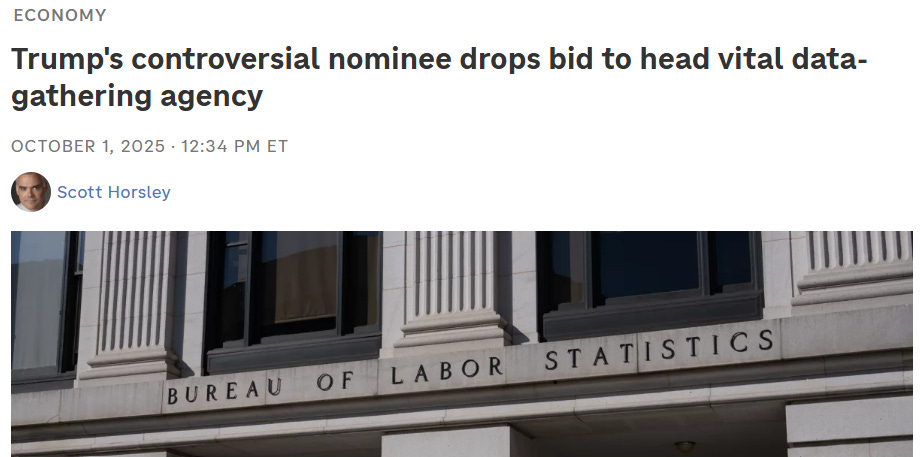
Recall: Trump nominated Antoni after BLS produced jobs numbers that he (Trump) didn’t like, but even some conservative economists didn’t like Antoni.
Mick Mulvaney—who gave up being a Tea Party congressman to become a MAGA CFPB/OMB Director, then flamed out as Trump’s Chief of Staff in his famous “get over it” rant—has been taking some Ls.
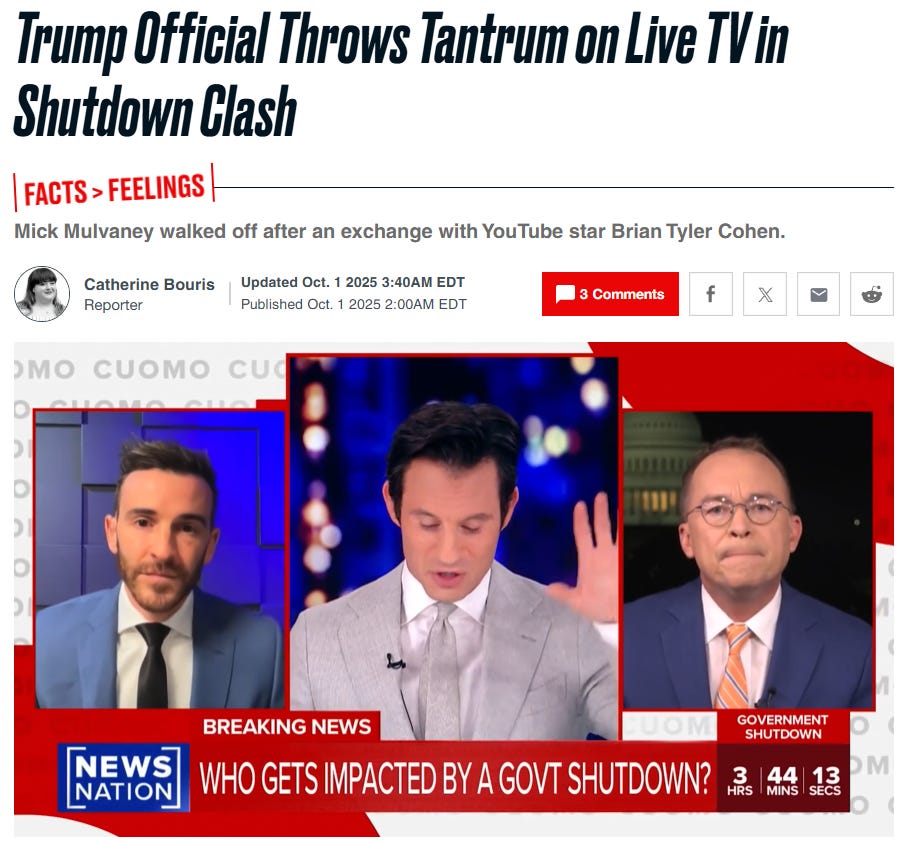
He no works as a talking head on TV (this makes sense because he has a track record of good and correct takes). But: nailed on the fact that the ACA does not make federal healthcare dollars available to undocumented immigrants, Mulvaney . . . sort of stuttered and got mad.
Does anyone else remember when he started a hedge fund? Seems they were liquidated. Get over it?
Over at the Congressional Research Service, former CFPBer Karl Schneider reports on the Bureau’s 1033 rule:
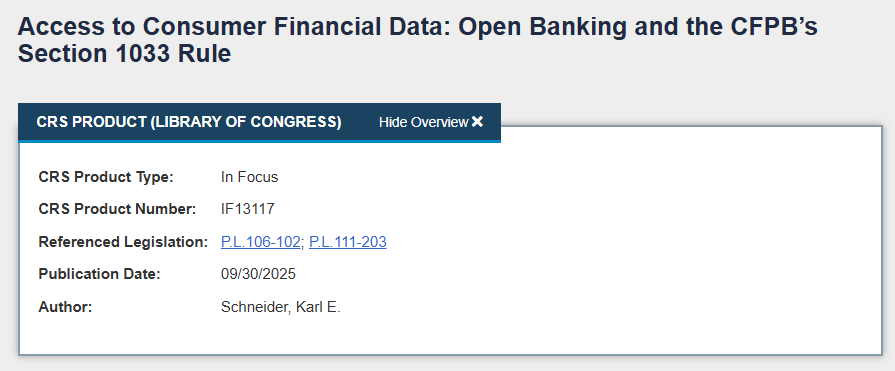
It’s a great primer for a topic that is currently pitting banks against fintechs:
Open banking refers to a relationship among consumers, financial services providers, and authorized third parties that enables consumers to transfer their information electronically from one firm to another for varied purposes. Motivations for open banking include making it easier to move financial accounts between providers and enabling free flow of information to novel applications. However, the degree to which adoption of open banking should be market-driven by industry due to consumer demand or regulation-led is debated. Open banking also relates to a broader policy issue regarding ownership of data and the degree to which data should belong to a consumer or to the financial institution.
Section 1033 of the Dodd-Frank Wall Street Reform and Consumer Protection Act (P.L. 111-203) requires covered financial institutions to make available to consumers upon request certain data associated with their accounts, subject to rules prescribed by the Consumer Financial Protection Bureau (CFPB). The CFPB finalized a rule in October 2024, with implementation originally set to begin in April 2026. Currently, the rule is the subject of litigation and reconsideration by new CFPB leadership.
And finally, some potpourri:
Happy 5 years of posting to Jason M at Fintech Biz Weekly! He celebrated with a characteristically great post: Coinbase Goes Scorched Earth to Protect “Rewards”
Former CFPB Director Rohit Chopra went viral for a tweet about Sec. Bessent, and apparently has great eyesight? Am I the only one who can’t read the text in the picture? Rohit also had a good thread and article on the Argentina bailout.
Brad Setser and Stephen Paduano in the FT: Other people’s money, and the problem with Mileism.
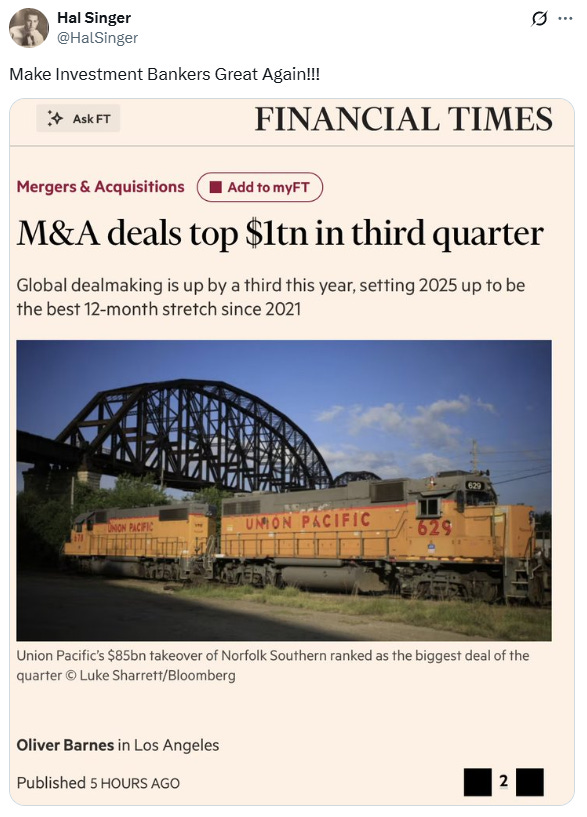
Jared Kushner and the Saudis are taking EA private in the biggest LBO ever. That Kushner must be a real talent to have such connections to Riyadh . . . .
In laborland and NYT, Starbucks Union member Cassie Pritchard asks: How Did My Fellow Baristas End Up on the Front Lines of a Culture War? And baby, she’s one of us: a poster.
“You can now buy products directly on ChatGPT.” Impossible to imagine how many 1L contracts hypos that this will produce.
Bloomberg: White Men Make a Comeback in America’s Boardrooms
CNBC: FTC sues Zillow and Redfin, alleging antitrust violation in online rental listings
Tariffs are going badly, ever so badly.
But: US vows to maintain tariffs regardless of Supreme Court ruling
Look, we’re in a recession.
Jane Goodall was secretly a huge hater.


[1] I am like 60% sure I have seen this joke elsewhere, but I can’t find it. If I stole this, sorry. If not, hell yeah.
[2] The campus in the picture is the campus of Harvard. Harvard, which is a college just outside of Boston. I know that because I currently am in law school at Harvard. In other words, I am an attendee of Harvard Law School, which is at Harvard. I go to Harvard.
 | A guest post by
|