
Hi,
Readers know I love when financial institutions do freaky little things such as open a café or (new this week!) introduce a line of beers. But it’s not just food stuff! In particular: it has come to my attention that the good folks at Charles Schwab have proposed a new holiday called “National Investing Day,” and I love it. It’s coming up this week! They even made a logo for it!

Hahahahahaha this rocks. Schwab describes the holiday as “an investor education and empowerment initiative encouraging people to dedicate at least one day in the year to explore how they can get invested and stay invested for a strong financial future.” More specifically, the holiday commemorates when the SEC eliminated “fixed commission rates” for securities sales on May 1, 1975, which eventually allowed Schwab to open as a discount brokerage and blah blah democratize investing, here’s the press release. (The company has also provided this record of “milestones” in Charles Schwab’s career in connection with the holiday, which we can refer to for holiday purposes as the Parable of the Chuck.)
At this point you are probably thinking “Ben, I am totally bought in. But how do I celebrate this joyous day? Is it customary to give gifts? What important rituals, dances, feasts, and/or prayers accompany this solemn event?” And my god if the folks at Schwab haven’t already offered answers:

Festive!
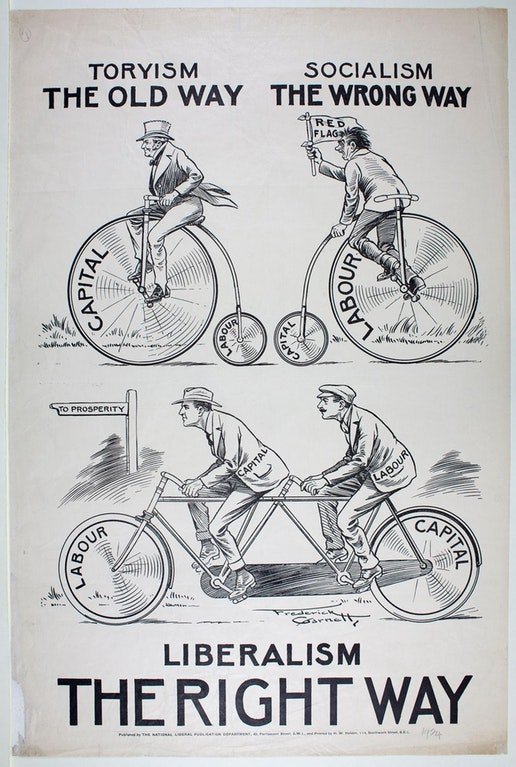
But the real point, as you may have noticed from the mention above of May 1, is that National Investing Day magically coincides with May Day, aka International Workers’ Day, aka the day the American Federation of Labor chose to commemorate the general strike that followed the Haymarket bombing in 1886. I love it. In a mixed economy marked (aspirationally?) by reasonable cooperation between labor and capital, we now have a choose-your-own-adventure day where both sides of the economic coin can feel celebrated.
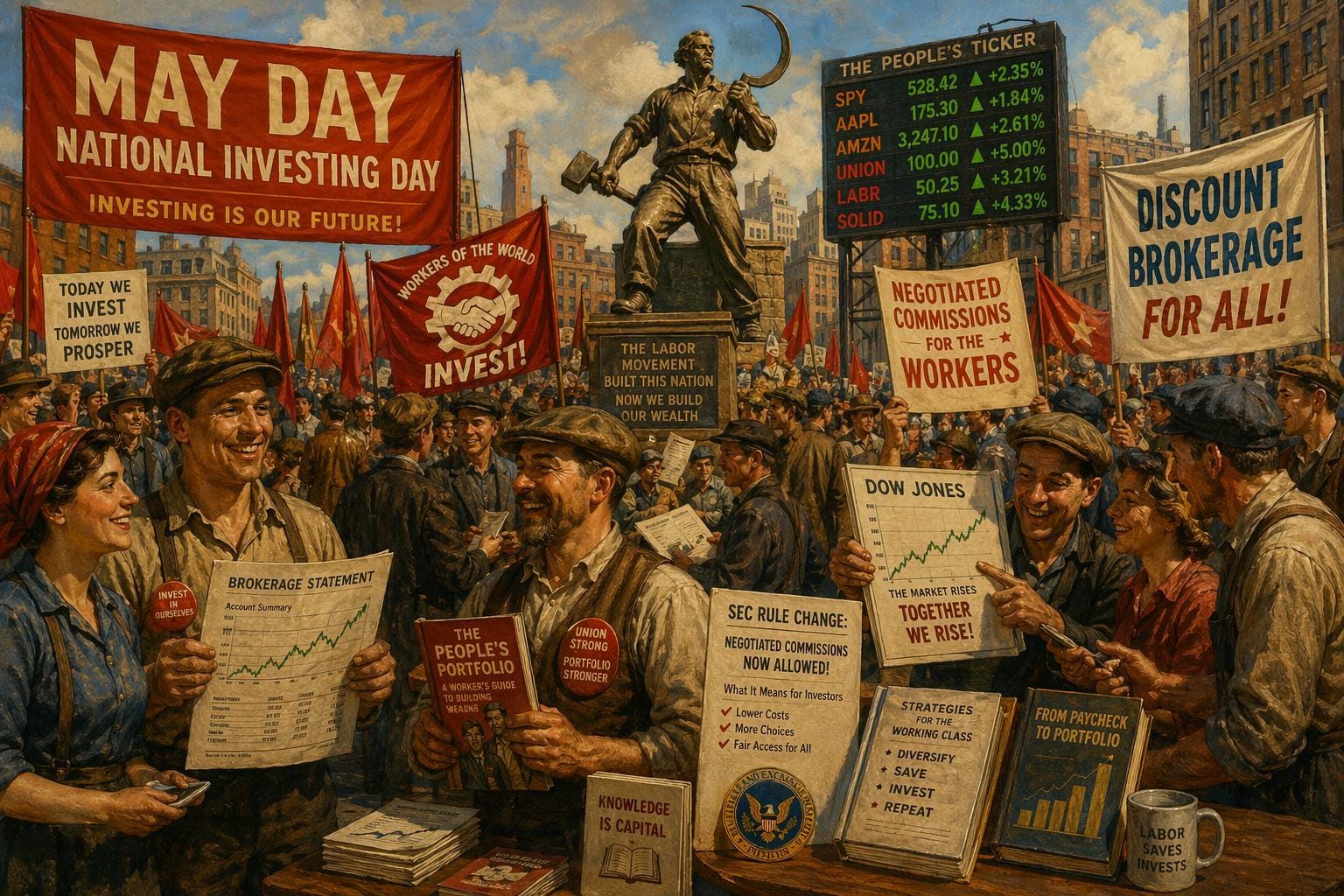
This all warms my heart, particularly given that discount brokerages are essentially about bringing investing to the masses. Here’s a pic from last year’s (inaugural!) celebration, to whet your holiday appetite:
Anywho. Keep scrolling for the best of the last week on the rich topic of consumer debt. It promises to be . . . celebratory.
So without further ado. . .
This Week In Debt for April 27, 2026:
Trump CFPB guts fair lending rules. The cornerstone of American fair lending law is the Equal Credit Opportunity Act (ECOA). The Consumer Financial Protection Bureau (CFPB) is the government agency that has authority over ECOA and its implementing rule, Regulation B. We talked back in December about a CFPB proposal to gut ECOA by revising Regulation B in a variety of nasty ways. And now (emphasis added):
The Trump administration’s CFPB finalized a rule rolling back fair lending enforcement by eliminating a tool used to weed out unintended bias and making it harder to bring claims that lenders discouraged borrowers based on race, gender, or other characteristics.
They sure read the “64,500+ comments” that people submitted on the draft rule quickly! To summarize the results (here is the final rule):
No more disparate impact claims. Traditionally, ECOA has been read to ban discrimination both when it is overt and when it arises through actions that are facially neutral but nevertheless discriminatory. Allegations of the latter type of discrimination are called “disparate impact” claims. People read ECOA to include disparate impact claims because . . . I mean, we are all adults and can dream up hypos of lending rules that are facially neutral but also obviously discriminatory.
The Bureau, however, will no longer be so imaginative. Instead, its new Reg B says that “ECOA does not authorize disparate-impact claims” (page 2), so only intentional discrimination will be outlawed going forward.
For a sense of what’s on the Trumps’ minds as they do this, here’s a snippet from page 138 of the rule (emphasis added):
Covered persons’ [i.e., lenders’] profitability could increase as a result of the provisions by improving operational flexibility and spurring innovation in the credit application process. For example, covered persons can experiment more with risk-based pricing and automated underwriting with reduced risk of facially neutral policies with disproportionate effects triggering liability without intent.
Sure the innovation may be discriminatory. But that’s only under the old rules! And in the meantime, the discrimination could be profitable!
Basically killing “discouragement.” Historically, one aspect of Reg B was that you couldn’t discourage groups of people you didn’t like from applying for a loan. So for example, you couldn’t put a “Blacks need not apply for loans” sign on your bank. One lender sort of de facto did this in the 2010s, and the CFPB went after them, and the Trump 2.0 admin got very huffy about the CFPB having done that, and so the Trumps recently tried to get that company out of trouble (and failed! ha).
But under the new Reg B, people claiming discouragement would basically have to meet a likely impossible standard in that they will have to show that a lender both specifically said something that they (the lender) knew or should have known is discriminatory about a given group, and that they connected those statements to some indication of whether they would lend to people in that group. That is likely to be . . . quite rare, in addition to it obviously going far beyond what is actually necessary to discourage people in a colloquial sense from applying for loans from a given company.
Way fewer special purpose credit programs. One thing ECOA historically did was let lenders have programs through which they could try to reach certain financially marginalized groups of people so that they (the lenders) could meet “special social needs.” But no longer! Or at least it’ll be much harder now. In particular, the revised Reg B says you now can’t base the design of a special purpose credit program on factors like people’s race, sex, etc. It also places new limits on whether and how lenders can use other characteristics like age to design those programs, and it creates a new, higher standard that lenders will have to meet to show that consumers subject to a given program would be unable to access credit without it. Short of that bar, the program basically has to go.
One interesting thing will be how this all fares under the Supreme Court’s recent decision in Loper Bright, which basically says that courts get the final word on what statutes mean. That case is relevant because a lot of the new Reg B is, on its own terms, only what the Trump CFPB has decided represents the “best reading” of ECOA (see, e.g., page 34). So under Loper Bright, the Trump CFPB’s new rule is mostly just their opinion on ECOA, and a federal court court say otherwise.
But until then . . . bad stuff, folks. (Also h/t to friends of the house Seth Frotman and Tara Mikkilineni, who called it in a blog post last year positing that “The Trump Administration Wants to Reboot Redlining.”)
Elsewhere, per LinkedIn: What RIF? CFPB is hiring.
Risks to the system and whatnot. The banks are lending a lot to non-banks. Hmmm (emphasis added):
That’s according to the Federal Deposit Insurance Corp.’s (FDIC) 2026 Risk Review, which noted that outstanding balances of bank loans to so-called nondepository financial institutions (NDFIs) have increased at a compound growth rate of 22.7%.
That’s more than triple the rate of the next largest category (multifamily lending), the banking regulator said in its report . . . The FDIC said entities classified as NDFIs include private equity/private credit firms, insurers and mortgage lenders. The FDIC says there’s a risk here, though an indirect one.
“In an economic downturn, NDFIs may need to sell assets, causing downward pressure on asset values that can affect valuations for assets pledged for collateral or held by other NDFIs and banks,” the report said.
“NDFIs that rely on less stable funding sources could also face significant liquidity stress due to margin calls on collateral pledged under their bank facilities.”
Risky! Or maybe not? We sort of don’t know yet. Luckily, the SEC and CFTC are stepping in to . . . make it so that people won’t have to report as much on their exposure to private credit. Nice.
Elsewhere: Thoma Bravo’s $5.1B Medallia wipeout deepens software, private credit reckoning.
Student loan grab bag!
Scary stories from inside the transfer of the federal student loan portfolio. The Trumps have been trying to transfer the student loan portfolio to Treasury so that they can further dismantle the Department of Education (ED). I have written that I think this move is both substantively pointless and likely to hut people. This week, we got news confirming how absurd and dangerous the move will be, and revealing that borrowers who are already struggling are going to be first in line for the fallout (emphasis added throughout):
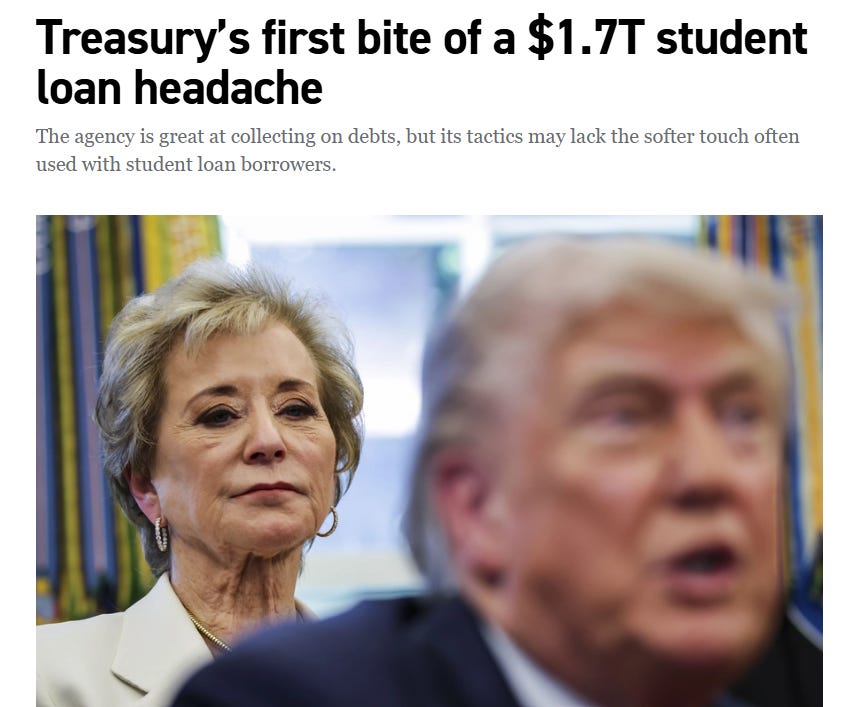
Student loans in default will be the first piece of the portfolio to be moved over, with the Education Department arguing that Treasury is best suited to handle them because of its history of collecting other federal debts. But current and former federal student aid officials say Treasury has more experience with forced-collection tactics, like seizing wages to repay loans, and is not well-versed in the more flexible options available to student loan borrowers to get out of debt and repair their credit. That shift could eventually create new financial pain for the 10 million borrowers already in default . . .
Not that ED is actually good at delivering the flexibility defaulted borrowers are entitled to under the law. But the Trumps are doubling down on the “Treasury can do it better” line. (In another article, for example, Undersecretary of ED Nick Kent said Treasury has “better talent” and “better systems” than ED, which uh, at least one of those things is sorta bitchy to say?) Trump 1.0-era student loan legend A. Wayne Johnson disagrees, particularly with respect to whether Treasury can ensure sure that borrowers will be able to access available pathways out of default:
[In Trump 1.0] “Treasury told us, in no uncertain terms, that they did not want to have anything to do with [defaulted federal student loans],” said Wayne Johnson, the chief operating officer at Federal Student Aid during the first Trump administration. “They didn’t have the capacity to handle the collections, and they certainly had no understanding about the concepts of basically resolving a default or a delinquency. They were in the business of very intense, hardcore collections.”
Finally, for a sense of what ED is planning on handing Treasury, here’s an anecdote from a New Yorker profile from this week on “How Professional Wrestling Prepared Linda McMahon for Trump’s Cabinet” (emphasis added):
[A] staffer who worked in Federal Student Aid, which is being moved to Treasury, told me, “The data is such a hot mess, and it’s such a privacy disaster. How do you move forty million subprime loans with records quite literally in bunkers in Nebraska on microfiche?”
Ha yeah this will end well.
The Trumps are letting a predatory for-profit walk away with taxpayer dollars. We often talk here about how when the Trumps are confronted with the conflict between nominally aiming to eliminate federal waste/fraud/abuse and actually wanting very badly to help the for-profit college sector despite it being a unique locus of waste/fraud/abuse, the for-profit colleges always win. They just won again (emphasis added):
The University of Arizona will not be financially liable for the $72 million in federal loans discharged by the federal government in 2023 for former students of Ashford University, which the public flagship acquired in 2020 and rebranded as University of Arizona Global Campus.
The backstory is that Ashford was a fraud of a for-profit college chain that got caught lying to students about things like graduation rates. Many of those students ultimately had their federal loans cancelled (that is, because they were defrauded), and in the meantime the U of Arizona bought Ashford so it could expand its online course offerings. But the taxpayer dollars underlying the cancelled loans had already been paid to Ashford, and ED could have tried to get them back. (They tried to do this with DeVry, though uh, that’s its own saga.) Now, ED won’t do that.
Sallie Mae points to more private credit partnerships in its earnings call, and the Department lends a hand. We’ve talked about how student loan companies are increasingly reliant on private credit dollars to make loans, and how those dollars could maybe dry up as tsuris rises in private credit land. The private student lender Sallie Mae, however, just reported the opposite, particularly w/r/t anticipated new lending to grad students. Here’s their CFO in their earnings call this week (emphasis added):
[W]hen we launched the inaugural partnership with [the private credit company] KKR last year, we indicated that it was our intention to build this into a business. . . . And we’ve started discussions with some of the folks that are involved in our process last year and weren’t the final sort of partner that we went with. . . . [W]e’re confident that we’ll get something done [i.e., a new private credit partnership] by the end of this year. . . . [T]hat initial KKR partnership was really sized and scoped to deal with our traditional undergrad student loan product. And so we always knew that we were going to need to expand and grow that to be at scale for the grad opportunity, and we’re working on getting ahead of that so that we have something in place in advance of when the major increase in volume from when [the end of Grad PLUS because of the Big Bill] comes online.
That is, they expect more private credit partnerships to arrive soon, particularly to support new lending to grad students. It’s all very timely given the following announcement from the Trumps last week (emphasis added):
In OBBBA, Congress stated that $257,500 was “the maximum aggregate amount of [federal student] loan” that could be “made, insured, or guaranteed” to any student “other than a Federal Direct PLUS loan . . . .”
At first, the Education Department, which was tasked with interpreting the law and ironing out its details, said this meant that existing Grad PLUS borrowers—regardless of when they finished their degree—would be exempt from the lifetime loan limit.
. . .
But now, the Education Department appears to have reversed its interpretation of the law and is saying that certain Grad PLUS borrowers are not exempt.
Read: the Big Bill created a new lifetime limit on federal lending to each student, and ED originally said existing borrowers didn’t have to count Grad PLUS loans toward that limit, but then ED changed its mind and now those students do have to count Grad PLUS loans toward that limit. That move means a lot of current grad students are about to do some combination of a) take on increasingly horrific private loans to continue paying for their education, and b) not finish programs they have already started, for lack of funds. Great job, guys.
Elsewhere: They Chose Careers in the Trades and Still Wound Up With Debt.
Americans are relying even more on BNPL to afford basics, but they are still falling behind. A new survey from LendingTree finds:
Nearly half of buy now, pay later users say they’ve paid late on a BNPL loan in the past year. 47% of users say they’ve paid late in the past year, up from 41% in 2025 and 34% in 2024. (Another 15% say they’ve paid late before, but not in the past year.) . . .
More than half of BNPL users say they wouldn’t be able to make ends meet without these loans. Among users, 54% agree that they need BNPL loans to make ends meet. Just 25% disagree. Among users most likely to say they need the loans to make ends meet: 62% of parents with kids younger than 18 and 59% of millennials.
Twice the rate of users have bought groceries with BNPL than two years ago. 29% of BNPL users say they’ve used the loans for groceries, up from 25% a year ago and 14% two years ago. . . .
1 in 4 BNPL users have had three or more active BNPL loans at one time. That’s up slightly from 23% last year. . . . In addition, 68% of BNPL users agree that the loans cause them to overspend, and 54% of BNPL users say they’ve regretted buying with BNPL, including 18% who’ve regretted it multiple times.
In addition, LendingTree finds that almost half of BNPL applicants are not “very confident” they’ll be able to pay back their loan. Ughhhhh.
(This is actually from earlier in the month, h/t to Amee Vanderpool at Shero for flagging.)
And finally, some potpourri:
We talked last week about how the Trumps are using “preemption” to go after certain new consumer protections in Illinois. And just like that, they’ve already published an interim final rule to that end.
That was fast!
Cool new paper from Sharon Cornelissen at the Consumer Fed on how reform of the Federal Home Loan Banks could address rising housing costs. Previously: vague gestures from me toward the idea that the FHLB’s seem somehow likely to be involved in the next crisis.
New evidence (lordy, there are emails!) from the California attorney general’s office illustrates how Amazon colludes with competitors to raise the price of everyday goods (h/t Lee Hepner).
New CRS report estimates that the revenue-optimizing corporate tax rate is “about 70%.”
“Fintech appeals SDNY ruling that earned wage advance product constitutes consumer credit”
Apparently the government agency that regulates pensions in the U.K. is charmingly called “The Pensions Regulator.” Elsewhere: the student loan programme.
A guy who tweets about small community banks has taken over my feed. I’m not sure his actual thesis is right (that is, that community banks represent some undiscovered repository of investor value because folksy folksy blah blah, that you can uniformly ID value based on the bank’s cookies and firm handshakes, etc), but ya gotta love it:
 Dirt Cheap Banks@dirtcheapbanksMy wife left me in the spring of the year I bought my seventh community bank. She said I had become unreachable. She was correct. I had spent the previous eleven months reading 20-year charge-off histories for a $62 million market cap bank in eastern Tennessee and I had, in a7:26 PM · Apr 23, 2026 · 51.9K Views31 Replies · 45 Reposts · 1.01K Likes
The Style Section
Pool, movie theater at FLW’s Taliesin West.
New Jersey datacenter expansion “got $77m in tax breaks to create exactly one permanent job.”
“Pupper, makerspace, I just can’t:” a fascinating of dead Millenialisms from the internet.
The video of RFK JR breathing during a Senate hearing is worse than you think.
Jia Tolentino as Forbes 30 under 30 criminal.
George HW Bush apparently used to drink ten cups of coffee per day.
Anne Hathaway said “inshallah.”


Have a great week!