

Brian Johnson's CFPB Will Start with Training Wheels
This Week in Debt: July 27, 2026

Hello,
Capital One exec Brian Johnson had his confirmation hearing last week to lead the Consumer Financial Protection Bureau, and it was . . . short. Senator Warren had great questions about Brian’s potential conflicts with his current employer and about corruption generally, Van Hollen asked about enforcement, and Warnock asked about whether Brian wanted to eliminate the Bureau. (Also Bernie Moreno, Republican of Ohio, asked at ~35 minutes for CFPB to investigate the online used car lender/dealer Carvana??? Despite the GOP previously being extremely testy about the Bureau touching anything related to auto??? And generally not wanting the Bureau to do anything at all??? Though Moreno is a car dealership guy, so at the very least it makes sense he’d dislike Carvana.)
Overall, though, it was pretty meh. Brian didn’t disclaim the current leadership’s actions at CFPB, but he didn’t endorse killing the agency either. (Low bar, folks!) Brian also said he would keep an “open mind” about staffing levels. It all appeared that he was playing things down the boring lane.
Anyway, whatever noncommittal things Brian said must have bothered someone in the White House, because the next day we got this:

That is, Russ Vought, the “conservative ideologue” who leads the CFPB as a part-time job while wanting the agency dead, will now be staying on staff at the agency past his term’s expiration on August 1. Surely it’s not so he can maintain access to the gym in the basement of the Bureau’s (former?) G street office.
Instead, Vought staying on shows where the BriJo CFPB could be headed. Last week, we went over some frameworks for thinking about how Brian might run the agency if confirmed. But that discussion might have been too narrow. Specifically, I might have focused too much on Brian himself and his own style and preferences, leaving out the broader policymaking apparatus on whose behalf he will be working. That apparatus is called “the Trump administration.” Vought staying in-house at CFPB for some period of time after his term ends is certainly at least consistent with the White House wanting to make sure the agency remains on a path that matches the administration’s preferences as closely as possible for as long as possible. Maybe that’s . . . what the rest of the Brian Johnson CFPB will consist of as well? Where Vought was an ideologue with his own clear preferences, and the White House gave him leash to enthusiastically implement them, early indications may be that Brian will sort of just be a flunky, and that the White House will take steps to enforce that status.
Also man, you’d think they’d have like a modicum of message discipline and try to use Brian’s seeming middle-of-the-road-ness as a tool to sanewash any continued attacks on the Bureau. It wouldn’t work—I would still have a substack—but like, you’d think they would try!
Anyway. We don’t yet have a date for a vote on Brian’s nomination, but you can keep track here.
In the meantime, I am taking the bar exam tomorrow and Wednesday, so this week’s edition of This Week in Debt will be a little uh breezy. Pray for me. (Not to be superstitious, but the hotel in the unnamed California city where I am taking the bar happens to be on G street? Seems good???) But I have still dutifully soldiered on and collected for you the best of the past week in consumer finance. See below on my behalf.
So without further ado . . .
This Week In Debt: 7/27/2026:
On student loans: “The poors will weld, and they will like it.” The way college used to work in America was more or less that it was an extreme luxury good. If you were rich, you went to college. If you were not rich, you did not go to college, regardless of how qualified you were. And you would miss out on the life and workforce opportunities that a college degree could entail. Then in 1965 Congress passed the Higher Education Act, which explicitly aimed to make postsecondary education broadly available because it was, as LBJ put it, “no longer a luxury but a necessity.” The result was a system that was imperfect in a variety of ways, but that really did make college broadly accessible to people regardless of who their parents were. (This is a simplified story that leaves out a lot, like the GI bill, but it’s basically right. A more detailed history lives here.)
Over time, the student aid system shifted from being more grant-based to being more loan-based. (In the 1975-76 school year, for example, 77 percent of federal student aid was grant-based; by 1995-96, 56 percent was loan-based. And so on.) Now America has $1.9 trillion of student loan debt, much of it in default, and the New York Times has headlines like this:

At the edge of a parking lot in the Arkansas Delta, LaDonna Glass slipped off her work boots and exchanged them for a pair of rainbow Crocs.
Glass, 23, had just finished her shift as an electrician apprentice in a veterinary school building across the lot. She snaked conduits between electrical boxes and installed wall sockets in an operating room big enough for a horse.
It was a full day of work she had enjoyed. It was also the kind of day she once worried would disappoint her parents and teachers.
“I was pretty brainy in high school, so everybody, I guess, they expected more out of me,” she said. “I felt like if I didn’t go to college, I would have been a failure.”
Glass is bubbly and curious, a lover of fantasy books, late-night workouts and gummy-bear-flavored lemonade. She graduated from high school in 2021 and went straight to Mississippi State University, with the goal of becoming a youth therapist.
But the road ahead seemed long and extraordinarily costly, and she began to question whether the investment would pay off. Her older brother had graduated from the same school with a degree in accounting. Afterward, he went to work as a truck driver.
To be clear, I think that people who want to work in skilled trades should be able to work in skilled trades. This story also has an “AI job-proofing” angle, which like I don’t know what will ultimately happen with the job market any more than anyone else.
But man, one of the strange consequences of the move to debt-based higher ed is that it seems to have created a situation where even the Times is cheerleading “brainy” people forgoing college because they can’t afford it. Under a debt based-paradigm, what was once a societal problem is now a sign of virtue. As Padmé put it:

It has been said that “America’s embrace of a debt-financed higher education model has broken the basic tenets of the social contract between the U.S. government and its citizens—the contract that relies on the supposed notion that higher education is the nation’s great equalizer; and that attending college always provides a clear pathway to the middle class.” This is what the consequences of that embrace look like. Surely we are better than this.
Elsewhere in student loans:
Business continues booming at Sallie Mae. The private student lending giant released its Q2 earnings and had its quarterly call last week. Things:
Guidance remains steady at 12 to 14 percent origination growth for student loans.
Sallie’s CEO reports that of that growth, “$4.5 billion to $5 billion” in new lending is attributable to the Trumps’ tightening of the federal PLUS loan program (that is, limiting Parent PLUS and eliminating Grad PLUS). For reference, Sallie’s lending before PLUS reform was usually about $6 to 7 billion per year total.
Sallie sold $3.75 billion in student loans to KKR in the first half of 2026, and they’re lining up a mystery second private credit buyer for the future. Regarding that burgeoning second partnership, Sallie’s CFO said (emphasis added):
[W]e’re negotiating the finer points of the economics. I feel really good about kind of how that process is going there, sort of openness to our asset class and their interest in both the traditional undergrad product that we have traditionally sold, but also at the margins, creating some opportunity for credit box expansion.
RED FLAG!!! RED FLAG!!! THEY ARE DOING ORIGINATE-TO-DISTIBUTE AND DIMINISHING THEIR UNDERWRITING STANDARDS ALONG THE WAY (THAT IS WHAT “CREDIT BOX EXPANSION” MEANS)!!!!! WE HAVE SEEN THIS MOVIE BEFORE, AND IT WON A LOT OF OSCARS BUT WAS VERY SAD AND DESTRUCTIVE IN REAL LIFE!!!
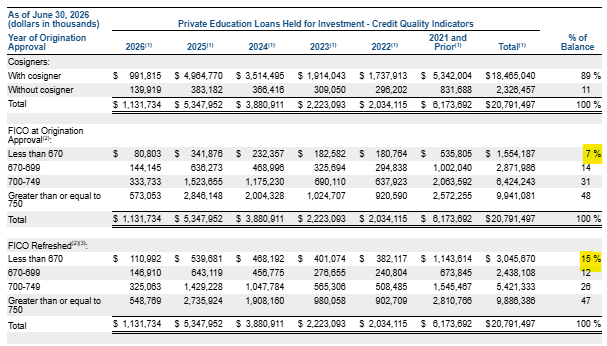
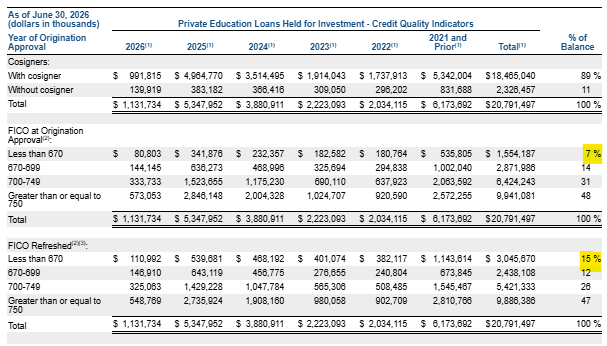
There was some real deterioration in credit quality? Specifically, 7 percent of Sallie’s student loan balances were to subprime borrowers at origination, but the subprime portion has risen to 15 percent as borrowers’ creditworthiness has been “refreshed” (that is, reassessed) while these loans have remained outstanding (highlights here are mine):
Though management pushed back during the earnings call on just how bad this is.
‘A bunch of red tape’: Student-loan borrowers can’t get clear answers from the companies that manage their debt (emphasis added):
Borrowers told Business Insider the problems extend beyond getting someone on the phone. Several said they were transferred between representatives, received conflicting guidance, or couldn’t get relevant answers. The confusion impedes their ability to budget for the future, whether it means putting money into retirement or affording the next grocery bill.
(Featuring PB!!!) A wave of student loan borrowers have entered default since pandemic-era protections lapsed. Lots of nice graphs.
Energy debt. Utility costs are rising, and people are increasingly going into debt to keep the lights on. Or so says a new report from the Century Foundation and Protect Borrowers that updates a November 2025 set of findings on the same topic (emphasis in original):
New analysis of consumer credit data by The Century Foundation and Protect Borrowers reveals a worsening utility debt crisis affecting nearly all corners of the country. . . .
Specifically, our analysis shows:
Energy bills have increased three times faster than the rate of inflation while Trump has been president. The national average monthly utility bill reached $280 in early 2026, an 12 percent increase since the end of 2024, just before the second Trump administration took office.
Typical monthly bills now exceed $280 in eighteen states across the country, with average costs rising by more than 20 percent in ten states since December 2024. Residents in Montana and New Hampshire have seen their average utility bills spike by 52 percent and 31 percent, respectively, since Trump returned to office.
Rising energy costs are causing more American households to fall behind. Since Trump took office, the national average overdue utility bill has increased by more than 8 percent since the end of 2024. In March of 2026, the national average overdue utility balance climbed to $817.
Black households and Americans with lower credit scores are most likely to struggle with utility debt. Financial strain is heavily concentrated among lower credit tiers, with 18 percent of deep subprime households carrying overdue utility balances. Energy debt also falls disproportionately along racial lines: Black households carry overdue utility debt at three times the rate of white households.
Middle-class households are not immune to the growing financial pressure of rising energy costs. Financial pressure from rising energy costs is climbing up the credit spectrum into moderate-credit consumers. Since December 2024, average overdue balances for subprime and near-prime households grew at roughly double the rate of deep subprime consumers (14 percent and 13 percent, compared to 7 percent).
Not good!
Not everyone gets a bank charter. I keep saying that under Trump 2.0, everyone who asks nicely gets a bank charter. I am wrong (emphasis added):
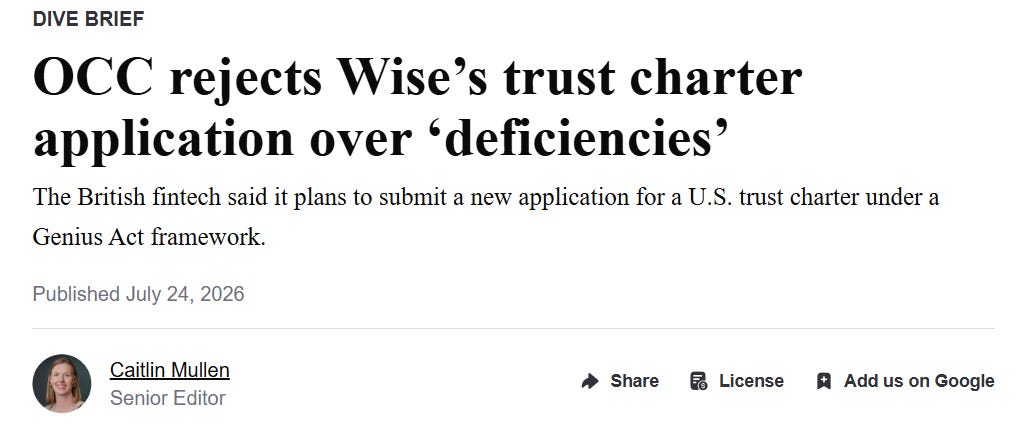
The Office of the Comptroller of the Currency has denied London-based Wise’s application to establish a national trust bank.
In a Tuesday letter, Stephen Lybarger, the OCC’s senior deputy comptroller for chartering, organization and structure, said Wise’s application “presents significant supervisory and compliance concerns.” He pointed to state regulatory actions taken against Wise related to anti-money laundering compliance and that organizers didn’t demonstrate “sufficient familiarity” with federal banking laws and regulations.
Wise plans to submit a new application to the OCC for a national trust bank charter under a Genius Act framework, the company said in a Thursday filing.
Ha man, things must be bad at Wise! I wasn’t under the impression that the Trump’s really cared about anti-money laundering, and in fact the Trump CFPB gave Wise one of its corporate pardons for some other activity. But there you have it. Maybe it’s that Wise is a UK bank, and MAGA likes “made in America"? Maybe there’s a campaign donation incoming to grease the wheels?
Meanwhile, the Rent Now Pay Later company Flex announced they’re working toward a bank charter in Utah:

I bet he’s thinking about bank charters. PB has written about how Flex charges low-income renters 180 percent APRs for loans on their rent. But our discussions on this substack should make clear that Flex would not be the dumbest or most predatory company to whom Utah has extended a bank charter (see, eg., the triple-digit APR puppy loans). Not to say that the state should do it, though.
Elsewhere:
Consumer Advocacy Group Urges Tenth Circuit to Allow Colorado to Regulate Interest Rates Charged by Out-of-State State Banks. (Background on that whole thing here.)
The Bank Policy Institute likes the so-called “Main Street Capital Access Act.”
Everyone wants to be a bank, but know what happens when you become a bank? You want also to be not a bank. Viz: Chime Unveils Investing Product, Diversifying Beyond Banking.
And finally, some potpourri:
The Dodd-Frank Act turned 16 on the 21st. UMich professor Jeremy Kress: “That means regulators are ~15 years late issuing incentive comp, source of strength & early remediation rules” (emphasis added).
Apple to Launch ‘Upgrade’ Device Leasing Program With Klarna to Spur Sales.
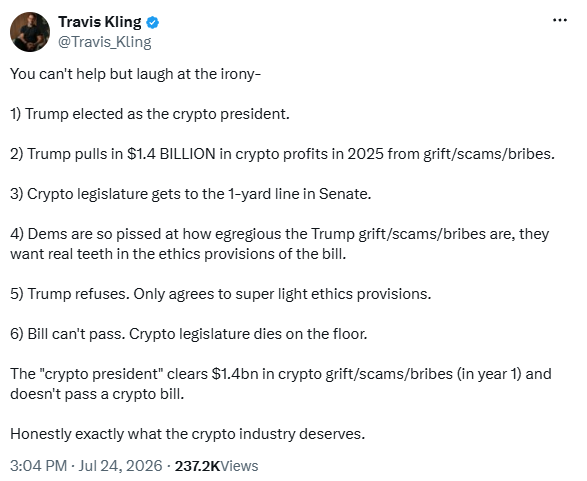
The clock appears to have run out on the big crypto market structure bill after the GOP refused to back stronger language barring public officials from trading digital assets. (That language came after Trump reported $1.4 billion in crypto revenue.) Ha. The crypto lobby may be ascendant, but money can’t buy everything! For now! Meanwhile, this tweet tidily sums up the state of things:
Former CFPB acting director and FHFA associate director Dave Uejio has a new paper at the Vanderbilt Policy Accelerator proposing a new plan for “expanding affordable housing supply without legislation.” TL;DR: community land trusts. His summary is available here. (emphasis added):
The 21st Century ROAD to Housing Act became law this month. It’s the most significant federal housing legislation since 1990, and it deserves the credit it’s getting — it’s a clear, bipartisan signal that we need to build more housing to address our affordability crisis.
It doesn’t settle what we build, or for whom.
That’s the gap this paper takes on. Community land trusts, resident-owned communities, and shared equity models produce homes that stay affordable permanently — not for 30 years, permanently. They’ve held up better than conventional homeownership through market cycles. They work in Missoula and Tulsa, not just Burlington.
And they’re stuck at roughly 44,000 homes nationally, against a housing stock of 145 million. A rounding error.
The reason isn’t that the model doesn’t work. It’s that America’s mortgage system treats every one of these loans as an exception — hand-underwritten, slow to close, locked out of the secondary market that makes conventional lending cheap and fast.
The paper maps what the federal government could do about that using authority it already has: standardized underwriting at Fannie and Freddie, different treatment under the multifamily caps, Duty to Serve reform, Federal Home Loan Bank programs pointed at permanence, and a capital facility to tie it together, all without new legislation or appropriations.
We talked last week about a new Pew report showing how debt collectors are increasingly using the courts as their debt collection piggy bank. This week, Ann Carrns at the Times also covered the report, and the debt collectors’ lobby gave a horrible statement to an Alabama publication (emphasis added):
“The core driver behind the rise in litigation is a systemic breakdown in communication. Litigation is typically a last resort, pursued only after cooperative outreach has been exhausted and primarily with consumers who can pay but choose not to engage,” ACA International said in a statement on Sunday, a trade organization that represents debt collection agencies.
. . .
ACA International said the reason for the increase in litigation comes from a breakdown in communication between creditors and debtors. The hurdles come from regulatory barriers imposed by the Consumer Financial Protection Bureau, credit reporting limits and misinformation.
“Social-media ‘finfluencers’ often tell consumers to ignore legitimate outreach,” the statement said.
The organization also said laws are already in place to protect debtors from having their assets seized.
Yes ACI it’s definitely the influencers’ and the CFPB’s fault that your members are robo-signing BS lawsuits in pursuit of default judgments.
Further damage could be coming for the Community Reinvestment Act:
Federal regulators are preparing to rewrite rules governing how banks lend to lower-income communities, abandoning an earlier plan to simply scrap the Biden administration’s overhaul and revert to decades-old standards, according to three people familiar with the effort.
Wonderful new website documents all the ways that brands you love have gotten Worse On Purpose.
Insurance grab bag!
Incredible new paper from Andrew Granto and Pranjal Drall: Private Credit’s State Backstop: How Private Equity Socializes Risk Through Insurers (emphasis added):
Private equity (PE) firms have acquired large life insurers and loaded their balance sheets with private credit assets that are opaque and difficult for regulators to value. This Article explains how PE profits from these insurers while shifting the resulting risk onto competitors and taxpayers.
Brian Shearer at the Vanderbilt Policy Accelerator: Property Insurers: Before You Increase Our Premiums Again, Sell the Private Jets. It includes heaters such as (emphasis added):
In 2023, 2024, and 2025 State Farm continuously threatened to leave California unless the commissioner approved a homeowners insurance price increase. They claimed they simply could not afford rising claims costs if they couldn’t raise prices. But what State Farm did have enough money for was four brand new private jets, which they bought in 2023 and 2024.
10th Circuit makes it harder for people to make claims under the Fair Credit Reporting Act.
Zombie mortgages are back. (Background.)
Brazil has a very good public payments system, and Trump is mad about it.
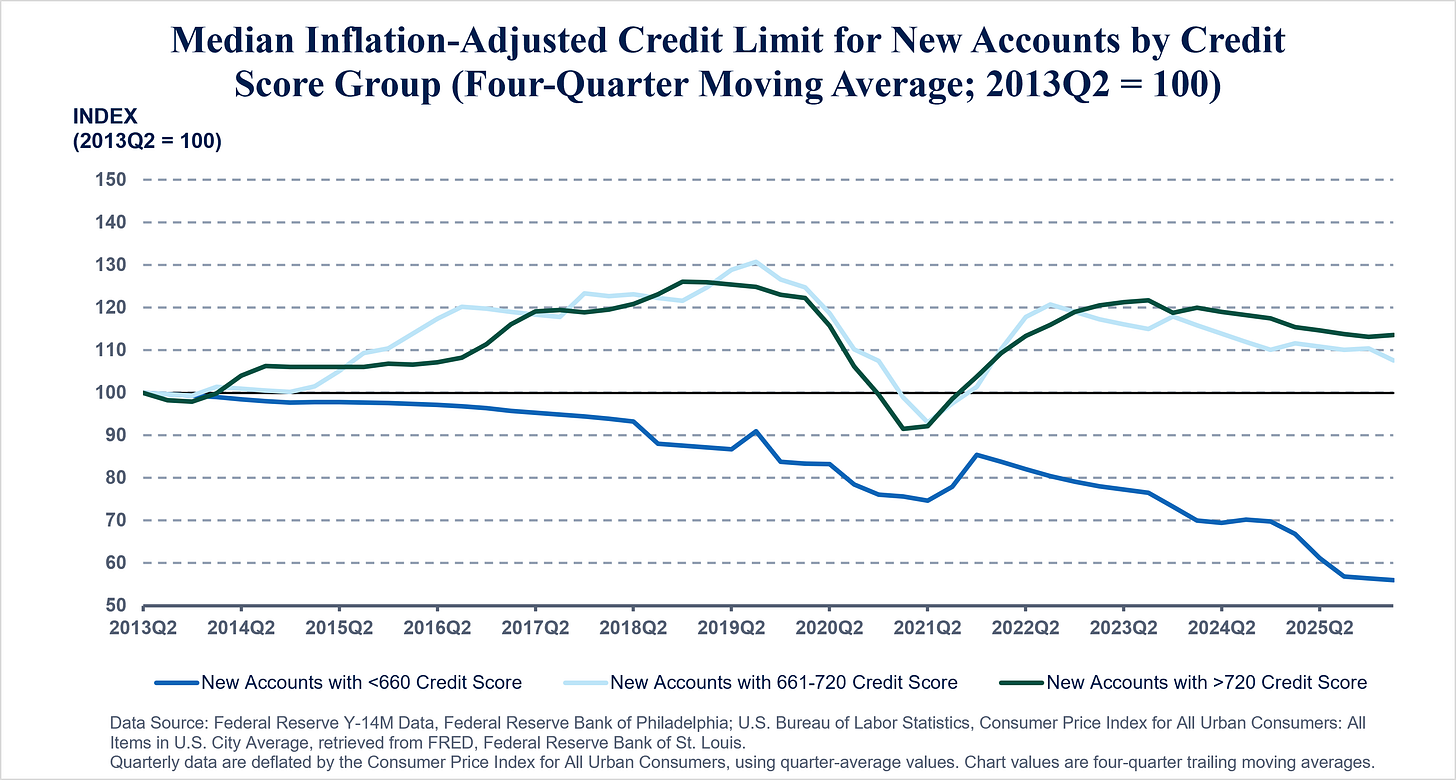
Philly Fed consumer credit report: Credit Card Borrowers Continue to Spend, While Mortgage Refinancing Surge Shows Pent-Up Demand. Jeez, look how credit card banks have narrowed access for less-than-prime borrowers, despite (as we discussed the other week) the bank lobby insisting that everyone should stop being mean to them because who else is acting as such a high-minded backstop for working families?
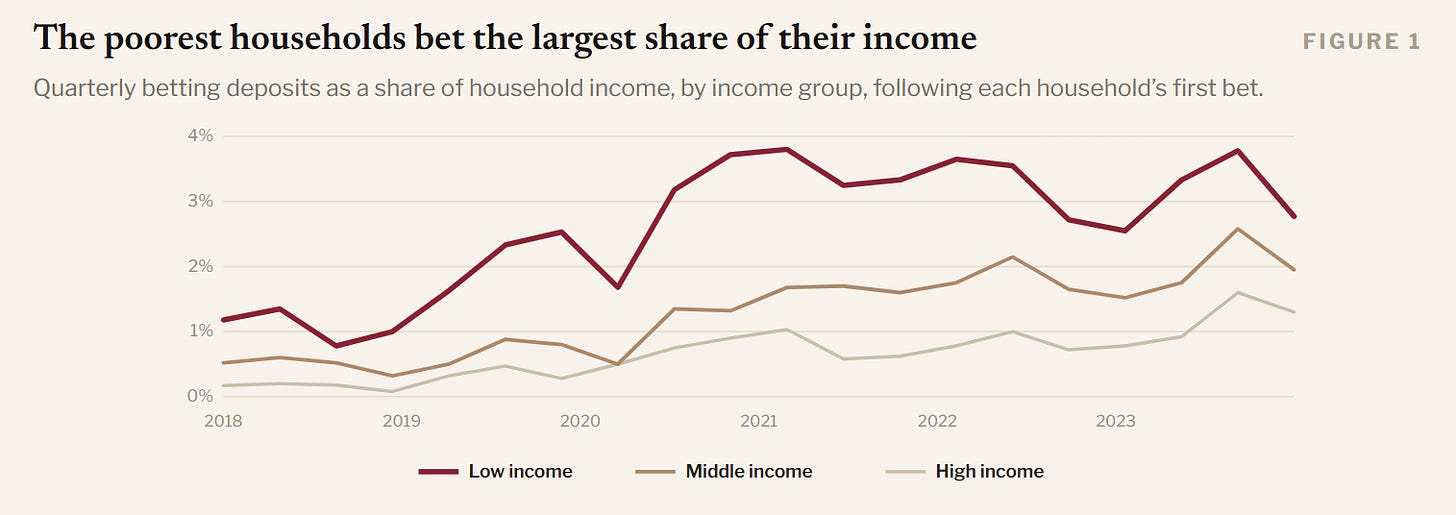
Cool new paper on sports gambling by Scott R. Baker, Justin Balthrop, Mark J. Johnson, Jason Kotter, and Kevin Pisciotta: Gambling Away Stability: How legal sports betting quietly reshapes the finances of vulnerable households. From a summary by one of the authors on LinkedIn:
Among our findings:
• Betting deposits grow sharply over time. Within three years of a household’s first bet, deposits are roughly eight times larger than at the outset.
• Frequent bettors reduce net investment deposits by more than 50% after legalization.
• Low-savings households increase credit-card debt relative to higher-savings households.
• Lower-income households bet a substantially larger share of their income than higher-income households.
• The effects appear specific to gambling rather than discretionary spending generally: major entertainment purchases do not produce the same decline in investing or increase in borrowing.
“[S]ince [Trump’s] re-election, we’ve lost 75,000 manufacturing jobs. Over the same period, Biden had created 625,000.”
Gold overtakes Treasuries as the world’s top reserve asset.
Inside the Fight for Consumer Protection: Q&A with Jennifer Zhang [of Protect Borrowers].
Apparently California’s mini-CFPB, the DFPI, gives its staff cool sheriff’s badges.
Options contracts for groceries.
Apollo: IPOs have been a losing bet since 2019.
The Style Section
Zohran: deregulator and big-tent Dem. (Meanwhile, in Florida: Faced With Piles of New Paperwork, People Are Losing Food Stamps)
“Hats off to the BBC copy editor for being able to come up with 7 different ways to say someone’s no longer employed” (Elsewhere: “Love how this Fast & Furious-themed menu at CityWalk just absolutely gives up on naming the last item.”)
Trinity of Love Island fame will be using her winnings (sorry, spoiler!) to pay down her student loan debt.
Social Darwinists to tech bros: tracing the long fight against equality in the US.
Nixon learns of TikTok edits.
Partisan divide in DC restaurant preferences.
NASA now sells “NASA-themed doughnuts” (h/t Jackie Filson).
“[H]ere’s Elon Musk confidently predicting fully self-driving Teslas by “next year’ for 10 years straight.”
ICYMI: there was nostalgia-posting this week about Emeril Lagasse. (When I was a small child I went to a recording of Emeril’s TV show. During the commercial break, Emeril gave all the kids ice cream.)







Have a great week!
 | A guest post by
|