

What Was the Vought CFPB?
This Week in Debt: July 20, 2026

Hi,
A long time ago, there was a guy named Mick Mulvaney. Mick was a Congressman from South Carolina who said that he opposed the Trump 1.0 admin. Then Mick went on to be Trump’s OMB director and acting CFPB director during the first term. While at CFPB, Mick did some pretty evil stuff to roll back the agency and its work. Mick eventually got promoted to be the acting White House Chief of Staff, at which point he left the Bureau. But he ultimately got canned from that new job after he told America to “get over it” when Trump tried to blackmail Zelensky in 2019. (Remember that?) Now Mick . . . idk, sometimes appears on TV, and at one point was maybe involved with a hedge fund? He is mostly remembered as having made one of the worst predictions of all time after leaving office. (More recently, he has gotten involved with lobbying against prediction market gambling, which is nice.)
My point is that Trump-adjacent flunkies like Mick come and go. As much as they seem giant while in power and do indeed hurt people through their work, they usually end up slinking into relative obscurity.
Now, we have a different conservative idealogue leading both CFPB and OMB. His name is Russell Vought, and this past week he testified before Senate Banking for the first and last time ahead of his CFPB term ending on August 1. (He also testified on the House side, where Maxine Waters memorably told him, “I’ve never delighted in someone’s failure more than I have delighted in yours.”)

The hearing was basically what you’d expect (except that Senator Kennedy, a Republican, called for keeping medical debt off of credit reports at like 48 minutes in?? Also Senator Tillis, who is also a Republican, dislikes DOGE, and said something about having to pick up “DOGE sh*t.”). Trump recently nominated Brian Johnson, a Capital One exec who was CFPB’s deputy director in Trump 1.0, to replace Russ. While the nomination is in the works, Russ’s deputy, Mark Paoletta, may take over as acting. Mark appears to be more on the incompetent side of evil.
What is there to say? The Vought era at the CFPB was a hostile effort to dismantle the agency on behalf of the wealthiest people and corporations in the world, with working families paying the price. The Vought CFPB attacked CFPB’s staff at every turn, gave endless handouts to corporate wrongdoers, and hacked away at protections that would have helped address the ongoing affordability crisis. The only time Vought waffled was when he wasn’t sure how to split the baby because handouts to one of his favored industries had unfortunately bothered one of his other favored industries. In some instances, as with the so-called “humility pledge,” the Vought CFPB was almost too cartoonish to be evil. In other cases, as with Vought’s recent attacks against immigrants, it was just evil.
So now what? A big question for the possibly upcoming Brian Johnson CFPB is where it might ultimately fall on the dual-axis chart of CFPB size and inactivity. Specifically, GOP-appointed CFPB directors have generally faced a tension between a) their desire for the CFPB not to exist, and b) their hope for the CFPB to do affirmatively evil things. Here’s how I’d put it:
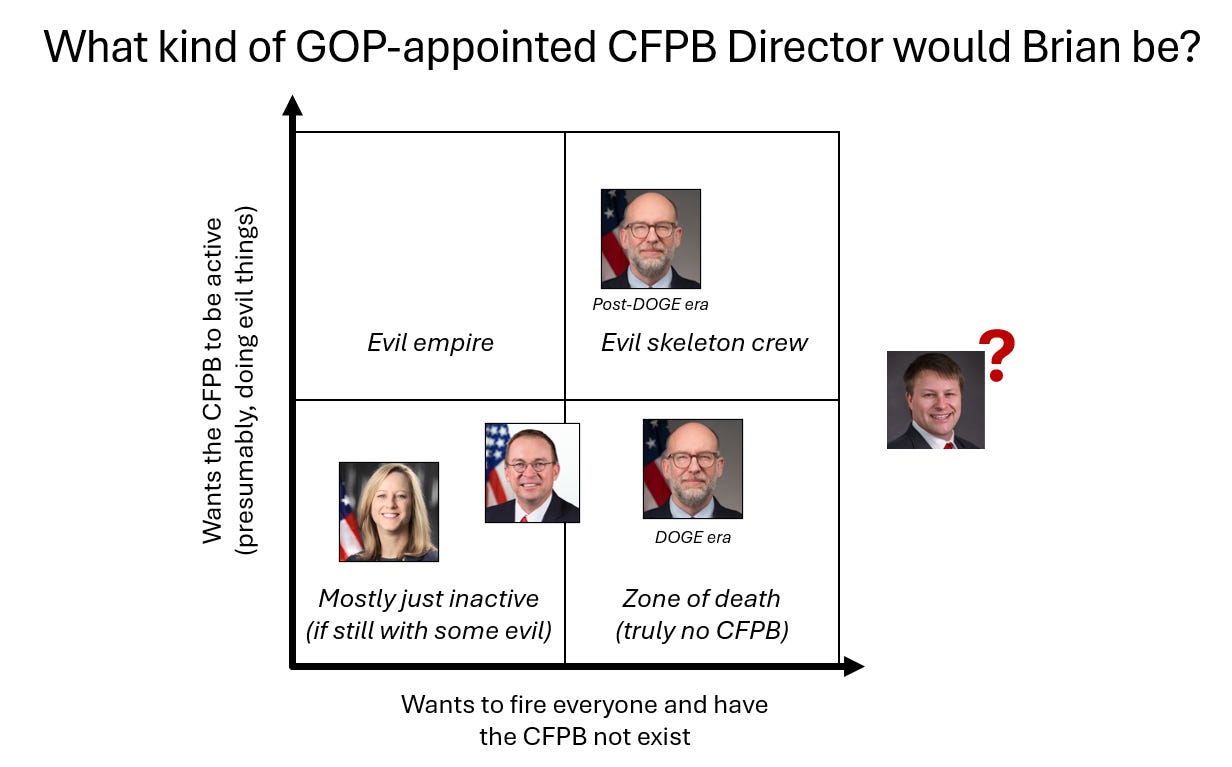
(Not to say that Kraninger didn’t do evil things, but I worked at CFPB when she was Director, and the vibe was definitely very “we are all mostly just sort of waiting this out.” Mulvaney was certainly more hostile than Kraninger, but he didn’t attempt any RIF-style mass firings in the way Vought has, and after all he did say “smaller, quieter.” Let me know what you think, I’m open to suggestions here.)
Vought struggled to manage the tension that those two axes represent. On one hand, man oh man, Vought really wanted to fire everyone! And he certainly tried. On the other hand, he never really figured out how to prevent his being fire-happy from kneecapping his other goals. E.g., ProPublica reported that understaffing at CFPB has recently made it hard for the Bureau to go after so-called “debanking.” “Debanking” is the conspiracy theory-type name that the Trumps have decided applies to any instance where they and/or their friends are denied banking services, even when those denials are for entirely legitimate reasons. We’ve also talked about how the Vought CFPB had trouble making progress repealing consumer data protections until it lost in court on the argument that the CFPB’s funding was illegal, meaning that the Bureau was able to continue attacking those protections only because a court ordered it to accept cash to keep the lights on. You can’t have it all, folks.
There are early indications that a Johnson CFPB could end up in the top left quadrant? Specifically: CFPB staff firings are on pause for now pending Johnson’s nomination, and the Bureau just announced a new and “Surprisingly Active” rulemaking agenda. (On the bright side, there is also reporting that the Trumps might end up reviving the Biden-era rule to cap credit card late fees, which is maybe not THAT surprising since the Trump 2.0 CFPB’s own research shows banks are making almost $20 billion a year from credit card late fees.) Only time will tell.
I guess all I have to offer by way of goodbye to the Vought CFPB is a statement that my boss Mike gave in early 2025 when the Bureau dropped a lawsuit against a rogue student loan servicer (emphasis added):
Of course, like all fascist toadies [Mike!!!], Russ Vought will rightly be forgotten by history and sink into well-deserved irrelevance. But until then, law enforcement at every level of government must rush in to fill the void left by a federal consumer protection agency that now stands only to serve billionaires and big corporations. Remember: these people prey on those in need because they are motivated only by the desire to exercise power, and they are motivated to do so because they are cowards. It is everyone’s job to remind Vought and his cronies of their powers’ limits, and to remind the world of their cowardice.
Now it’s Russ’s turn to slink, like Mick before him, into obscurity. (Or to start slinking, given Russ is still at OMB.) The rest of us will have to keep up our righteous fight. In the background, new polling shows broad, bipartisan support for a CFPB that actually does its job.
You know what won’t slink into obscurity, though? The links I have collected below from the last week concerning the rich topic of consumer financial protection. Scroll on, and be merry.
So without further ado . . .
This Week In Debt: 7/20/2026:
Fair housing. The old joke is that while most countries have a socialized system for healthcare and a private market for mortgages, the U.S. has a private market for healthcare and a socialized system for mortgages. Specifically (high-level here!), the way that the mortgage market works in the U.S. is that there are two so-called “government sponsored entities” (GSEs) called Fannie Mae and Freddie Mac, and their job is to buy up tons of mortgages about as soon as they’re made, bundle those loans into big pools, and sell pieces of those pools to investors. You can see how the question of “well which mortgages do they buy?” is important, not in the least because the most famous instance of our government deciding where mortgage credit should be allocated was the birth of “redlining.”
Now, in Shelterforce, Doug Ryan of Grounded Solutions Network writes that the Trumps want the GSEs to buy fewer mortgages from people in underserved markets (emphasis added):
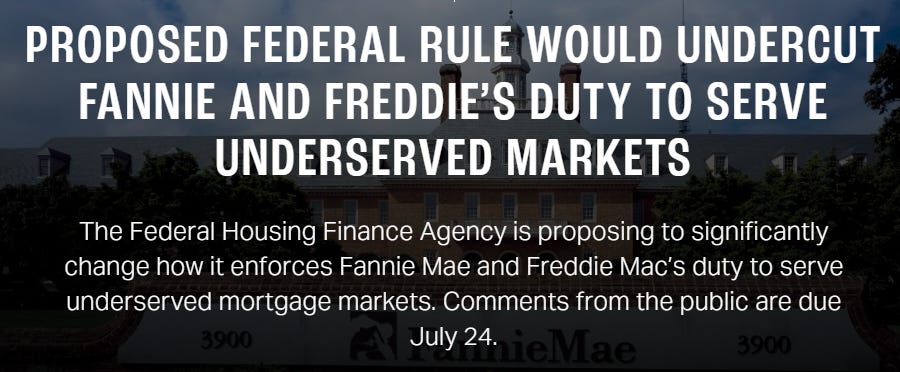
On June 24, the Federal Housing Finance Agency (FHFA), which regulates Fannie Mae and Freddie Mac, the two government-sponsored enterprises (GSEs) that back a majority of home loans in the United States, released a proposed amendment to the Duty to Serve (DTS) Underserved Markets rule. The amendment would significantly change what FHFA requires of the two GSEs under the Housing and Economic Recovery Act of 2008 (HERA). Of particular importance to Shelterforce readers, the amended rule would weaken the GSEs’ duty to serve homebuyers in underserved markets.
FHFA is allowing only a 30-day comment period, which is short for such consequential changes. Comments are due July 24, 2026.
At issue here is the “Duty to Serve” rule, which basically says that the GSEs have to do a decent job meeting the needs of underserved markets (think manufactured housing, affordable housing, rural housing). The rule traces back to the law the Bush administration passed to have the government formally take over the GSEs after they blew themselves up during the Financial Crisis.
The timing couldn’t be worse. Bloomberg reports: US Mortgage Rates Match Highest in Almost a Year, Purchases Drop (emphasis added):
The average contract rate on a 30-year fixed mortgage climbed 7 basis points to 6.65% in the week ending July 10, according to weekly Mortgage Bankers Association data published Wednesday. Meanwhile, the group’s index of mortgage purchase applications fell 7.3%.
Hmm. MLK famously said that the U.S. has “Socialism for the rich and capitalism for the poor.” Perhaps the issue the Trumps were aiming to address here was that poor people in the mortgage market were getting a little too much of that socialism. It’s the same Trump admin, after all, that already lowered the GSEs’ numeric affordable housing goals.

Enforcement grab bag! With the theme of: states stepping in as the CFPB recedes.
Block: Block (of CashApp) settles with states for $45 million over claims related to consumer fraud. And a bipartisan coalition of states at that, with Texas leading! Plus, on LinkedIn, PB’er Allison Preiss notes that the terms of the settlement include a requirement that Block abide by the terms of its Biden-era settlement with the CFPB, which required the payment of up to $120 million in consumer redress. Read: states affirmed the CFPB!
Michigan: The Dodd-Frank Act gives states the power to enforce federal consumer financial protections regardless of what the CFPB is up to. Michigan is picking up the mantle. The state just sued a solar company based in part on violations of the Dodd-Frank Act’s prohibition on unfair, deceptive, and abusive acts and practices.
Bad news: A new Brookings report outlines how enforcement by the banking regulators has declined over a decade, particularly at the Fed. E.g.: “In 2015, the Federal Reserve, Federal Deposit Insurance Corp. and Office of the Comptroller of the Currency issued more than 500 public enforcement actions . . . . Last year, they issued 245” (h/t Kate Berry).
Good news (from friends of the house!): Former Federal Consumer Protection Enforcement Leaders Launch Public Interest Law Firm Halperin Petersen & Mikkilineni.
Also, not like exactly on topic but still fun: New York State Department of Financial Services Secures $50 Million Penalty from Swedbank for Withholding Information from Investigators.
State courts are debt collection mills. Or so we have been saying here. Now, the bleeding hearts over at the Wall Street Journal are on the case (emphasis added):
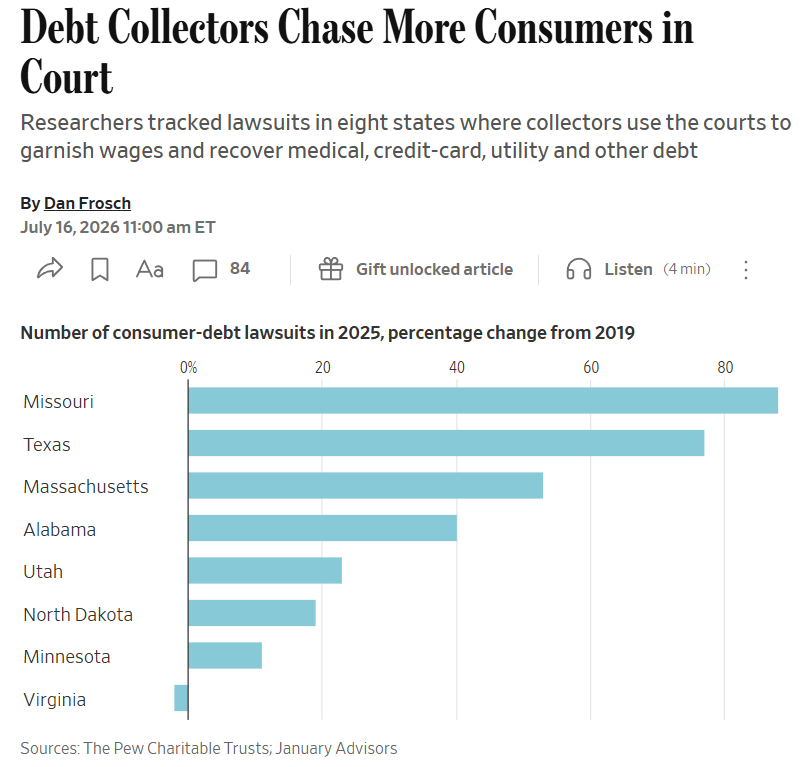
Lawsuits filed by debt collectors over unpaid credit-card bills and other outstanding balances have surged to their highest levels in years, according to a report released Thursday by the Pew Charitable Trusts.
The number of debt collection lawsuits filed in several states and metropolitan areas in 2025 outpaced prepandemic levels, continuing a trend that began a year earlier, according to the Pew report.
. . .
“This represents a lagging indicator that shows the financial and economic stress a lot of Americans have been facing over the past several years,” said David McClendon, a researcher with January Advisors, a data consulting firm that helped compile the report.
Another possibility: Debt collection firms are simply finding courts an efficient and lucrative path to recovering debt as Americans take on more of it.
YES RIGHT IT’S THE OTHER POSSIBILITY. Lester Bird, the author of the underlying report and a senior manager at Pew, helps show us why (emphasis added):
Some 70% [of cases] will end in default judgments for the creditor, Bird said, often because the borrower doesn’t realize they are being sued due to address changes or confusion over who is suing them, doesn’t know how to navigate the courts or doesn’t respond.
Those judgments mean that wages can be garnished directly out of the debtor’s paycheck, in addition to liens placed on their home or personal assets taken.
The fallout lands on exactly whom you’d expect:
Roughly half of those sued for debt earn at least 300% more than the federal poverty level, according to estimates from January Advisors. That is the equivalent to a household income of $99,000 for a family of four.
Sony video game bank charter. Humans have basic needs, such as food and shelter, and they have higher-order needs, such as self-actualization. Somewhere in that pyramid is the need for a bank charter. We’ve been talking a lot here about how the desire to be a bank and do bank-like things appears to be an enduring aspect of the human experience, and how under Trump 2.0 the folks who are meant to gatekeep who actually gets to have a bank charter (that is, the banking regulators) have more or less been giving charters to whoever asks nicely.
For example, Sony (yes, that Sony) asked for a bank charter so that it could issue stablecoins that people could use to buy things in video games, and it appears they asked nicely (emphasis added):
Sony Bank has secured conditional approval from the U.S. Office of the Comptroller of the Currency to establish a national trust bank, moving it closer to issuing a U.S. dollar-backed stablecoin through a new American subsidiary [called Connectia Trust].
. . .
The approval advances plans Sony first outlined last year when it applied to the OCC for a national trust bank charter through Connectia Trust. At the time, Sony said the proposed stablecoin would be pegged 1:1 to the U.S. dollar and used by American customers to pay for video games, anime, subscriptions and other digital content across its ecosystem . . . .
I guess the good Lord has called me to write one day about how the actions of an anime AI companion will lead to a real-world banking crisis. I just wish the OCC hadn’t facilitated this divine calling.
Elsewhere in banking:
The BNPL lender Klarna also applied for a bank charter.
States are writing in to oppose an effort by OppFi and Enova, two online loan sharks, to buy banks. (Previously.)
At Punchbowl, Brendan Pedersen reports that the so-called Main Street Capital Access Act is going to come to the floor of the House next week. If the name of that bill sounds sinister, it’s because the bill is a sinister bank deregulation package.
The New York Fed had a super super cool paper where they trained an AI on tens of thousands of old-timey news reports on bank runs so that we could learn more about what differentiates runs that actually turn into failures from ones that do not (answer: underlying solvency, mostly).
Student loan grab bag!
The Project on Predatory Student Lending has been hard at work:
Ninth Circuit denies the Department of Education’s appeal aiming to delay relief in Sweet.
The Wall Street Journal editorial board dislikes Public Service Loan Forgiveness.
Clint Combs at the Minnesota Spokesman-Recorder: Student loan changes leave Black borrowers bracing for higher payments.
Oh god what will this be: Trump officials pitch new solution to student debt problem:
The Trump administration is exploring how to launch a new student loan program — without the Education Department, an agency the president has promised to dismantle.
Administration officials, who have been discussing the idea in small industry groups, are trying to attract the private sector, according to two people who participated in one of the meetings. The plan, they said, involves having the Small Business Administration spearhead the program, even though the agency was passed over as the new home of the nation’s student loan portfolio.
And finally, some potpourri:
Seth Frotman and I wrote some things:
At the Capitol Forum: The 90-Year-Old Law That Shows How to Tame the Federal Courts.
At Harvard’s Civil Rights-Civil Liberties Law Review: Want “State Capacity”? That Means Private Rights of Action.
WSJ: Big Banks’ Profits Surge After a Red-Hot Quarter on Wall Street.
At the Consumer Federation of America, Sharon Cornelissen, Douglas Heller, Ethan Weiland, and Michael DeLong have a great new report: “REDLINED: The Persistence of Racial Inequality in the Cost of Homeowners Insurance.” From the press release (emphasis added):
Black and Hispanic consumers pay hundreds of dollars more on average each year in homeowners insurance premiums . . . .
The report, which examines homeowner insurance premiums and racial demographics in every ZIP code in the United States, found evidence of a substantial racial premium gap—a major upcharge for certain consumers. On average, homeowners in Black communities pay a 16% higher premium, or $500 more per year, compared to homeowners in white communities. Homeowners in Hispanic communities pay a 30% higher premium, or $950 more per year, compared to homeowners in white communities. Over a 30-year mortgage, this gap results in at least $15,000 in additional insurance premiums for Black homeowners and $28,500 in additional premiums for Hispanic homeowners.
The OECD is out with a newly revised Recommendation on Consumer Protection in the Field of Consumer Credit. It has a ton of new content on BNPL, AI, etc.
Massachusetts proposes new regs around medical debt credit reporting.
New York City takes action on junk fees, “click-to-cancel.”
Katie Fallon, Judah Axelrod, Manuel Alcala Kovalski, and Zach Neumann at Urban: How Property Managers Add Costs to Base Rent Through Fees.
JPMorgan, Bank of America and Other Banks Explore a Deal to Shake Up Payments World (this is about banks trying to find a way around the Durbin amendment, which basically limits interchange fees on debit cards):
Some of the largest banks in the country have been exploring an acquisition that could allow them to get around one of the laws they hate most: the limits on fees they earn on debit-card transactions.
China’s record consumer defaults undermine Beijing’s push to boost spending. (Previously.)
Judge questions limits of tribal immunity in Minnesota predatory lending suit.
Bill Gates’s daughter’s company might have done some fraud.
DraftKings Sues Philadelphia Over Consumer Protection Ordinance.
BLS reports that the median fast food worker is now making over $15/hr.
The Style Section
The path to a drunkard’s grave: “Plenty of pickles.”
Seinfeld cast in Gen Z fashion. (Also George as Tucker, and George on peptides. Really just a great week for Seinfeld AI.)
Nothing but respect for our boys in baja.
Posters of history: Benjamin Franklin, Union Senators.
Adults whose spicy food intake averaged six or seven days a week had a 14 percent lower relative risk of dying than those whose intake averaged less than once a week.
The rug from The Big Lebowski was just sold at auction.
WSJ: Two Banks Agreed to Merge. They Can’t Agree on How to Make Chili.


Have a great week!
 | A guest post by
|